AA HL · Geometry and trigonometry · course

Triangle trigonometry.

AA HL resourcesPDF

Any triangle can be solved from three of its measurements, as long as one is a side. The choice of rule depends only on what you are given: a side with its opposite angle calls for the sine rule, an angle between two known sides for the cosine rule.

ISolving a triangleSL 3.2 · right-angled ratios, sine rule, cosine rule, area

I.1 A right-angled triangle

Definition 1

the ratios in a right-angled triangle

For an acute angle $\theta$ of a right-angled triangle: $\sin\theta=\dfrac{\text{opposite}}{\text{hypotenuse}}$, $\cos\theta=\dfrac{\text{adjacent}}{\text{hypotenuse}}$, $\tan\theta=\dfrac{\text{opposite}}{\text{adjacent}}$.
Example 1

In the triangle $ABC$, $A\hat{C}B=90^{\circ}$, $AB=15$ cm and $B\hat{A}C=40^{\circ}$. Find $BC$ and $AC$.

What you do
What you write
Step 1 Label the sides from the angle $A$
$BC$ opposite, $AC$ adjacent, $AB=15$ hypotenuse
Step 2 Opposite and hypotenuse: $\sin$
$BC=15\sin40^{\circ}=9.64$ cm
Step 3 Adjacent and hypotenuse: $\cos$
$AC=15\cos40^{\circ}=11.5$ cm

Apply

  1. Hypotenuse $20$, angle $25^{\circ}$: the side opposite the angle.
    Answer$8.45$
  2. Opposite $7$, adjacent $4$: the angle.
    Answer$60.3^{\circ}$

I.2 The sine rule

Property 1

the sine rule, the cosine rule, the area

In any triangle $ABC$, side $a$ facing $A$, and so on: $\displaystyle \frac{a}{\sin A}=\frac{b}{\sin B}=\frac{c}{\sin C},\qquad c^{2}=a^{2}+b^{2}-2ab\cos C,\qquad \text{Area}=\frac12ab\sin C.$
Example 2

In the triangle $ABC$, $\hat A=48^{\circ}$, $\hat B=71^{\circ}$ and $a=12$. Find $b$.

What you do
What you write
Step 1 A complete pair: $a$ and $\hat A$
$\dfrac{12}{\sin48^{\circ}}$
Step 2 Write the sine rule
$\dfrac{b}{\sin71^{\circ}}=\dfrac{12}{\sin48^{\circ}}$
Step 3 Solve, calculator in degrees
$b=15.3$

Apply

  1. $a=9$, $\hat A=30^{\circ}$, $\hat B=80^{\circ}$: find $b$.
    Answer$17.7$
  2. $a=8$, $\hat A=40^{\circ}$, $b=6$: find $\hat B$.
    Answer$28.8^{\circ}$

I.3 The cosine rule: a side

Watch out 1
The sine rule needs a complete pair: a side and the angle opposite it. Two sides and the angle between them: the cosine rule. In Paper 2, the calculator in degrees.
Example 3

In the triangle $ABC$, $a=8$, $b=11$ and $\hat C=72^{\circ}$. Find $c$.

What you do
What you write
Step 1 Two sides and the angle between them: cosine rule
$c^{2}=8^{2}+11^{2}-2\times8\times11\cos72^{\circ}$
Step 2 Compute $c^{2}$
$c^{2}=130.61\ldots$
Step 3 Square root
$c=11.4$
Figure 1 — At $90^{\circ}$ the cosine rule becomes Pythagoras.

Apply

  1. $b=5$, $c=9$, $\hat A=110^{\circ}$: find $a$.
    Answer$11.7$
  2. $a=7$, $b=15$, $\hat C=60^{\circ}$: find $c$ exactly.
    Answer$c^{2}=169$: $13$

I.4 The cosine rule: an angle

Example 4

A triangle has sides $6$, $9$ and $13$. Find its largest angle.

What you do
What you write
Step 1 The largest angle faces the longest side
the angle $C$ opposite $13$
Step 2 $\cos C=\dfrac{a^{2}+b^{2}-c^{2}}{2ab}$
$\cos C=\dfrac{36+81-169}{108}=-0.481\ldots$
Step 3 Inverse cosine: obtuse is fine
$C=118.8^{\circ}$

Apply

  1. Sides $4$, $5$, $6$: the largest angle.
    Answer$82.8^{\circ}$
  2. Sides $7$, $8$, $9$: the smallest angle.
    Answer$48.2^{\circ}$

I.5 The area of a triangle

Example 5

Find the area of the triangle with $a=10$, $b=13$ and $\hat C=38^{\circ}$.

What you do
What you write
Step 1 Two sides and the angle between them
$\frac12ab\sin C$
Step 2 Substitute
$\frac12\times10\times13\times\sin38^{\circ}$
Step 3 Compute
$40.0$

Apply

  1. Sides $12$ and $7$, angle $140^{\circ}$ between them: the area.
    Answer$27.0$
  2. Area $25$, sides $8$ and $10$: the acute angle between them.
    Answer$\sin C=0.625$: $38.7^{\circ}$

IIBearings and elevationSL 3.3 · bearings, angles of elevation and depression, labelled diagrams

II.1 Bearings

Definition 2

bearing, elevation, depression

A bearing is measured clockwise from north, with three figures: $060^{\circ}$. The angles of elevation and depression are measured from the horizontal.
Property 2

north lines are parallel

The north lines at two points are parallel. The bearing of $A$ from $B$ is the bearing of $B$ from $A$ plus or minus $180^{\circ}$.
Example 6

A ship sails $8$ km on a bearing of $040^{\circ}$. How far north and how far east has it gone? What is the bearing back to its start?

What you do
What you write
Step 1 Draw north; the angle is from north
right-angled triangle, angle $40^{\circ}$ at the start
Step 2 North: adjacent; east: opposite
$8\cos40^{\circ}=6.13$ km, $8\sin40^{\circ}=5.14$ km
Step 3 Back bearing: $+180^{\circ}$
$220^{\circ}$

Apply

  1. The bearing of $A$ from $B$ is $300^{\circ}$: the bearing of $B$ from $A$.
    Answer$120^{\circ}$
  2. $15$ km on a bearing of $210^{\circ}$: how far south and west?
    Answer$13.0$ km; $7.5$ km

II.2 A journey in two legs

Watch out 2
Draw the north line at every point you turn at. The angle of depression from $T$ to $A$ equals the angle of elevation from $A$ to $T$.
Example 7

A boat sails $7$ km from $P$ on a bearing of $030^{\circ}$ to $A$, then $9$ km on a bearing of $110^{\circ}$ to $B$. Find $PB$.

What you do
What you write
Step 1 Back bearing at $A$
bearing of $P$ from $A$: $210^{\circ}$
Step 2 The angle at $A$
$210^{\circ}-110^{\circ}=100^{\circ}$
Step 3 Cosine rule
$PB^{2}=7^{2}+9^{2}-2\times7\times9\cos100^{\circ}=151.88\ldots$
Step 4 Square root
$PB=12.3$ km
Figure 2 — Exam-style question 3. Bearings are measured clockwise from north.

Apply

  1. $5$ km on $090^{\circ}$, then $12$ km on $180^{\circ}$: the distance and the bearing of the end from the start.
    Answer$13$ km; $157.4^{\circ}$

II.3 Angles of elevation and depression

Example 8

From a point $50$ m from the foot of a tree, the angle of elevation of its top is $28^{\circ}$. Find the height of the tree.

What you do
What you write
Step 1 Draw the horizontal, the angle from it
right angle at the foot of the tree
Step 2 Opposite and adjacent: $\tan$
$\tan28^{\circ}=\dfrac h{50}$
Step 3 Solve
$h=26.6$ m

Apply

  1. From the top of a $60$ m cliff, the angle of depression of a boat is $18^{\circ}$: its distance from the foot of the cliff.
    Answer$185$ m
  2. A kite string $40$ m long makes $55^{\circ}$ with the ground: the height of the kite.
    Answer$32.8$ m

IIIExam-style questionsfrom the shortest to the longest · every one in steps, with its marks

A Solving a triangle

Exam-style question 1Paper 2 · calculator · [Maximum mark: 6]

In the triangle $ABC$, $AB=9$ cm, $AC=6$ cm and $B\hat{A}C=50^{\circ}$.
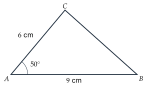
the diagram of the question
(a)Find $BC$.[2]
(b)Find the area of the triangle $ABC$.[2]
(c)Find $A\hat{B}C$.[2]
More questions like this

Working (a)

What you do
What you write
Step 1 Two sides and the angle between them: cosine rule
$BC^{2}=9^{2}+6^{2}-2\times9\times6\cos50^{\circ}$
Step 2 Square root
$BC=6.90$ cm ($6.89774\ldots$)

Working (b)

What you do
What you write
Step 1 $\frac12ab\sin C$
$\dfrac12\times9\times6\sin50^{\circ}$
Step 2 Compute
$20.7$ cm$^{2}$ ($20.6831\ldots$)

Working (c)

What you do
What you write
Step 1 Sine rule with the side just found
$\dfrac{\sin B}{6}=\dfrac{\sin50^{\circ}}{6.89774\ldots}$
Use the unrounded value of $BC$.
Step 2 Inverse sine
$A\hat{B}C=41.8^{\circ}$ ($41.7854\ldots$)

Play this question in Mark it: find each mark yourself →

Exam-style question 2Paper 1 · no calculator · [Maximum mark: 5]

In the triangle $PQR$, $PQ=4$, $PR=6$ and $Q\hat{P}R=60^{\circ}$.

(a)Find $QR$, giving your answer in the form $k\sqrt7$.[3]
(b)Find the exact area of the triangle $PQR$.[2]
More questions like this

Working (a)

What you do
What you write
Step 1 Cosine rule
$QR^{2}=4^{2}+6^{2}-2\times4\times6\cos60^{\circ}$
Step 2 $\cos60^{\circ}=\frac12$
$=52-48\times\dfrac12=28$
$\cos60^{\circ}=\frac12$.
Step 3 Simplify the root
$QR=2\sqrt7$

Working (b)

What you do
What you write
Step 1 $\frac12ab\sin C$, $\sin60^{\circ}=\frac{\sqrt3}2$
$\dfrac12\times4\times6\times\dfrac{\sqrt3}{2}$
$\sin60^{\circ}=\frac{\sqrt3}{2}$.
Step 2 Simplify
$6\sqrt3$

Play this question in Mark it: find each mark yourself →

B Bearings (Paper 2)

Exam-style question 3Paper 2 · calculator · [Maximum mark: 7]

A ship sails from a port $P$ on a bearing of $060^{\circ}$ for $12$ km to a point $A$. It then sails on a bearing of $150^{\circ}$ for $9$ km to a point $B$.
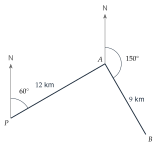
the diagram of the question
(a)Show that $P\hat{A}B=90^{\circ}$.[2]
(b)Find the distance $PB$.[2]
(c)Find the bearing of $B$ from $P$.[3]
More questions like this

Working (a)

What you do
What you write
Step 1 Back bearing at $A$
the bearing of $P$ from $A$ is $060^{\circ}+180^{\circ}=240^{\circ}$
Or: co-interior angles on the north lines, $180^{\circ}-60^{\circ}=120^{\circ}$, then $120^{\circ}-30^{\circ}$.
Step 2 Subtract the bearings
$240^{\circ}-150^{\circ}$
Step 3 Conclude
$P\hat{A}B=90^{\circ}$

Working (b)

What you do
What you write
Step 1 Pythagoras
$PB^{2}=12^{2}+9^{2}$
Step 2 Compute
$PB=15$ km

Working (c)

What you do
What you write
Step 1 $\tan$ of the angle at $P$
$\tan A\hat{P}B=\dfrac{9}{12}$
Step 2 Compute the angle
$A\hat{P}B=36.8699\ldots^{\circ}$
Step 3 Add to the first bearing
$060^{\circ}+36.87^{\circ}=096.9^{\circ}$
Add the bearing of $A$: $B$ is clockwise from $A$.

Play this question in Mark it: find each mark yourself →

C Angles of elevation (Paper 2)

Exam-style question 4Paper 2 · calculator · [Maximum mark: 5]

From a point $A$ on level ground, the angle of elevation of the top $T$ of a tower is $32^{\circ}$. From a point $B$, $40$ m closer to the tower on the same straight line, the angle of elevation is $50^{\circ}$.
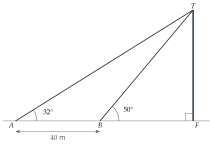
the diagram of the question
(a)Find $A\hat{T}B$.[1]
(b)Find $BT$.[2]
(c)Find the height of the tower.[2]
More questions like this

Working (a)

What you do
What you write
Step 1 Exterior angle of triangle $ABT$
$50^{\circ}-32^{\circ}=18^{\circ}$
The exterior angle of triangle $ABT$ at $B$ is $50^{\circ}$.

Working (b)

What you do
What you write
Step 1 Sine rule in triangle $ABT$
$\dfrac{BT}{\sin32^{\circ}}=\dfrac{40}{\sin18^{\circ}}$
Step 2 Compute
$BT=68.6$ m ($68.5941\ldots$)

Working (c)

What you do
What you write
Step 1 Right-angled triangle at the foot: $\sin$
$h=68.594\ldots\times\sin50^{\circ}$
The right-angled triangle at the foot of the tower.
Step 2 Compute
$h=52.5$ m ($52.5461\ldots$)

Play this question in Mark it: find each mark yourself →

IVWhich method? Read the questionthe whole topic on one page

The question says
You write
The triangle in the question has a right angle: use SOH CAH TOA.
the ratio with the two sides involved D1
The triangle has no right angle, and you know a side, its opposite angle and one more value: use the sine rule.
$\frac{a}{\sin A}=\frac{b}{\sin B}$ P1
You know two sides and the angle between them, and want the third side: use the cosine rule.
$c^{2}=a^{2}+b^{2}-2ab\cos C$ P1
You know the three sides of a triangle and must find an angle: use the cosine rule, rearranged.
$\cos C=\frac{a^{2}+b^{2}-c^{2}}{2ab}$ P1
You must “find the area” of a triangle that has no right angle: use $\frac12ab\sin C$.
two sides and the angle between them P1
A ship or a walker travels “on a bearing of” a given angle: a bearing is measured clockwise from north.
a north line at each point; back bearing $\pm180^{\circ}$ P2
Someone looks up or down at an object, with an “angle of elevation” or “of depression”: it is measured from the horizontal.
a right-angled triangle, often two of them D2
In the exam 1

command terms

Find: the rule with the numbers in it, then the answer to $3$ s.f., angles to $1$ decimal place. Show that: every step, ending on the given value. Exact: surds, no decimals.