IB Mathematics

Analysis and approaches,
Higher Level.

Everything in AA SL, then proof, complex numbers, vectors in space and further calculus, with a third paper.

1 pack available, 6 planned.

notion by notion

Exam papers.

Everything here is a PDF to download, notion by notion: the course, marked examples with an exercise under each, then more practice. Free opens a few marked examples; Premium opens the course, one marked example and its exercise in every sub-notion, and a practice sheet per notion; Excellence opens everything.

1Proof, complex numbers and countingplanned

Counting principles, partial fractions, complex numbers in every form, De Moivre, proof by induction and by contradiction.

1Course

The course of each sub-notion: definitions, results, methods, and the notation the markscheme expects.

  • Counting principlesPremium
  • Complex numbers in every formPremium
  • De Moivre's theoremPremium
  • Proof by induction and contradictionPremium

2Marked examples

Each example comes with its full markscheme, mark by mark. Under it, a similar exercise to do on your own.

  • Counting principlesExample 1PremiumExercise 1PremiumExample 2ExcellenceExercise 2ExcellenceExample 3ExcellenceExercise 3Excellence
  • Complex numbers in every formExample 1PremiumExercise 1PremiumExample 2ExcellenceExercise 2ExcellenceExample 3ExcellenceExercise 3Excellence
  • De Moivre's theoremExample 1PremiumExercise 1PremiumExample 2ExcellenceExercise 2ExcellenceExample 3ExcellenceExercise 3Excellence
  • Proof by induction and contradictionExample 1PremiumExercise 1PremiumExample 2ExcellenceExercise 2ExcellenceExample 3ExcellenceExercise 3Excellence

3More practice

Further exercises in the style of Paper 1 and Paper 2, with their answers.

  • The whole notionPractice sheet, 12 questionsPremiumExam-style paper, with markschemeExcellence
  • Counting principlesPractice set, 8 questionsExcellence
  • Complex numbers in every formPractice set, 8 questionsExcellence
  • De Moivre's theoremPractice set, 8 questionsExcellence
  • Proof by induction and contradictionPractice set, 8 questionsExcellence
2Polynomials, rational functions and inequalitiesplanned

Factor and remainder theorems, sums and products of roots, rational functions, odd and even functions, inequalities.

1Course

The course of each sub-notion: definitions, results, methods, and the notation the markscheme expects.

  • Factor and remainder theoremsPremium
  • Sums and products of rootsPremium
  • Rational functionsPremium
  • InequalitiesPremium

2Marked examples

Each example comes with its full markscheme, mark by mark. Under it, a similar exercise to do on your own.

  • Factor and remainder theoremsExample 1PremiumExercise 1PremiumExample 2ExcellenceExercise 2ExcellenceExample 3ExcellenceExercise 3Excellence
  • Sums and products of rootsExample 1PremiumExercise 1PremiumExample 2ExcellenceExercise 2ExcellenceExample 3ExcellenceExercise 3Excellence
  • Rational functionsExample 1PremiumExercise 1PremiumExample 2ExcellenceExercise 2ExcellenceExample 3ExcellenceExercise 3Excellence
  • InequalitiesExample 1PremiumExercise 1PremiumExample 2ExcellenceExercise 2ExcellenceExample 3ExcellenceExercise 3Excellence

3More practice

Further exercises in the style of Paper 1 and Paper 2, with their answers.

  • The whole notionPractice sheet, 12 questionsPremiumExam-style paper, with markschemeExcellence
  • Factor and remainder theoremsPractice set, 8 questionsExcellence
  • Sums and products of rootsPractice set, 8 questionsExcellence
  • Rational functionsPractice set, 8 questionsExcellence
  • InequalitiesPractice set, 8 questionsExcellence
3Vectors, lines and planesplanned

Scalar and vector products, equations of lines and planes, intersections, angles and distances.

1Course

The course of each sub-notion: definitions, results, methods, and the notation the markscheme expects.

  • Scalar and vector productsPremium
  • Equations of linesPremium
  • Equations of planesPremium
  • Angles, intersections, distancesPremium

2Marked examples

Each example comes with its full markscheme, mark by mark. Under it, a similar exercise to do on your own.

  • Scalar and vector productsExample 1PremiumExercise 1PremiumExample 2ExcellenceExercise 2ExcellenceExample 3ExcellenceExercise 3Excellence
  • Equations of linesExample 1PremiumExercise 1PremiumExample 2ExcellenceExercise 2ExcellenceExample 3ExcellenceExercise 3Excellence
  • Equations of planesExample 1PremiumExercise 1PremiumExample 2ExcellenceExercise 2ExcellenceExample 3ExcellenceExercise 3Excellence
  • Angles, intersections, distancesExample 1PremiumExercise 1PremiumExample 2ExcellenceExercise 2ExcellenceExample 3ExcellenceExercise 3Excellence

3More practice

Further exercises in the style of Paper 1 and Paper 2, with their answers.

  • The whole notionPractice sheet, 12 questionsPremiumExam-style paper, with markschemeExcellence
  • Scalar and vector productsPractice set, 8 questionsExcellence
  • Equations of linesPractice set, 8 questionsExcellence
  • Equations of planesPractice set, 8 questionsExcellence
  • Angles, intersections, distancesPractice set, 8 questionsExcellence
4Bayes' theorem and random variablesplanned

Bayes' theorem, discrete and continuous random variables, expectation and variance.

1Course

The course of each sub-notion: definitions, results, methods, and the notation the markscheme expects.

  • Bayes' theoremPremium
  • Discrete random variablesPremium
  • Continuous random variablesPremium

2Marked examples

Each example comes with its full markscheme, mark by mark. Under it, a similar exercise to do on your own.

  • Bayes' theoremExample 1PremiumExercise 1PremiumExample 2ExcellenceExercise 2ExcellenceExample 3ExcellenceExercise 3Excellence
  • Discrete random variablesExample 1PremiumExercise 1PremiumExample 2ExcellenceExercise 2ExcellenceExample 3ExcellenceExercise 3Excellence
  • Continuous random variablesExample 1PremiumExercise 1PremiumExample 2ExcellenceExercise 2ExcellenceExample 3ExcellenceExercise 3Excellence

3More practice

Further exercises in the style of Paper 1 and Paper 2, with their answers.

  • The whole notionPractice sheet, 12 questionsPremiumExam-style paper, with markschemeExcellence
  • Bayes' theoremPractice set, 8 questionsExcellence
  • Discrete random variablesPractice set, 8 questionsExcellence
  • Continuous random variablesPractice set, 8 questionsExcellence
5Differential calculuswritten

The SL core: rates of change, tangents, the chain, product and quotient rules, optimisation. Part of the HL course too.

1Course

The course of each sub-notion: definitions, results, methods, and the notation the markscheme expects.

  • Limits and rates of changePremium
  • Rules of differentiationPremium
  • Tangents and normalsPremium
  • The graphs of f, f′ and f″Premium
  • Stationary points and inflexionPremium
  • OptimisationPremium
  • KinematicsPremium

2Marked examples

Each example comes with its full markscheme, mark by mark. Under it, a similar exercise to do on your own.

  • Limits and rates of changeExample 1FreeExercise 1PremiumExample 2ExcellenceExercise 2ExcellenceExample 3ExcellenceExercise 3Excellence
  • Rules of differentiationExample 1PremiumExercise 1PremiumExample 2ExcellenceExercise 2ExcellenceExample 3ExcellenceExercise 3Excellence
  • Tangents and normalsExample 1FreeExercise 1PremiumExample 2ExcellenceExercise 2ExcellenceExample 3ExcellenceExercise 3Excellence
  • The graphs of f, f′ and f″Example 1FreeExercise 1PremiumExample 2ExcellenceExercise 2ExcellenceExample 3ExcellenceExercise 3Excellence
  • Stationary points and inflexionExample 1FreeExercise 1PremiumExample 2ExcellenceExercise 2ExcellenceExample 3ExcellenceExercise 3Excellence
  • OptimisationExample 1FreeExercise 1PremiumExample 2ExcellenceExercise 2ExcellenceExample 3ExcellenceExercise 3Excellence
  • KinematicsExample 1PremiumExercise 1PremiumExample 2ExcellenceExercise 2ExcellenceExample 3ExcellenceExercise 3Excellence

3More practice

Further exercises in the style of Paper 1 and Paper 2, with their answers.

  • The whole notionPractice sheet, 12 questionsPremiumExam-style paper, with markschemeExcellence
  • Limits and rates of changePractice set, 8 questionsExcellence
  • Rules of differentiationPractice set, 8 questionsExcellence
  • Tangents and normalsPractice set, 8 questionsExcellence
  • The graphs of f, f′ and f″Practice set, 8 questionsExcellence
  • Stationary points and inflexionPractice set, 8 questionsExcellence
  • OptimisationPractice set, 8 questionsExcellence
  • KinematicsPractice set, 8 questionsExcellence
5Further calculusplanned

Limits and L'Hôpital's rule, implicit differentiation, integration by parts and substitution, Maclaurin series, differential equations.

1Course

The course of each sub-notion: definitions, results, methods, and the notation the markscheme expects.

  • Limits and L'Hôpital's rulePremium
  • Implicit differentiationPremium
  • Integration by parts and substitutionPremium
  • Maclaurin seriesPremium
  • Differential equationsPremium

2Marked examples

Each example comes with its full markscheme, mark by mark. Under it, a similar exercise to do on your own.

  • Limits and L'Hôpital's ruleExample 1PremiumExercise 1PremiumExample 2ExcellenceExercise 2ExcellenceExample 3ExcellenceExercise 3Excellence
  • Implicit differentiationExample 1PremiumExercise 1PremiumExample 2ExcellenceExercise 2ExcellenceExample 3ExcellenceExercise 3Excellence
  • Integration by parts and substitutionExample 1PremiumExercise 1PremiumExample 2ExcellenceExercise 2ExcellenceExample 3ExcellenceExercise 3Excellence
  • Maclaurin seriesExample 1PremiumExercise 1PremiumExample 2ExcellenceExercise 2ExcellenceExample 3ExcellenceExercise 3Excellence
  • Differential equationsExample 1PremiumExercise 1PremiumExample 2ExcellenceExercise 2ExcellenceExample 3ExcellenceExercise 3Excellence

3More practice

Further exercises in the style of Paper 1 and Paper 2, with their answers.

  • The whole notionPractice sheet, 12 questionsPremiumExam-style paper, with markschemeExcellence
  • Limits and L'Hôpital's rulePractice set, 8 questionsExcellence
  • Implicit differentiationPractice set, 8 questionsExcellence
  • Integration by parts and substitutionPractice set, 8 questionsExcellence
  • Maclaurin seriesPractice set, 8 questionsExcellence
  • Differential equationsPractice set, 8 questionsExcellence
P3Paper 3 problem-solvingplanned

Extended investigations of the kind set in the HL Paper 3: one idea, followed through several parts.

1Course

The course of each sub-notion: definitions, results, methods, and the notation the markscheme expects.

  • Investigation and conjecturePremium
  • Generalising and provingPremium

2Marked examples

Each example comes with its full markscheme, mark by mark. Under it, a similar exercise to do on your own.

  • Investigation and conjectureExample 1PremiumExercise 1PremiumExample 2ExcellenceExercise 2ExcellenceExample 3ExcellenceExercise 3Excellence
  • Generalising and provingExample 1PremiumExercise 1PremiumExample 2ExcellenceExercise 2ExcellenceExample 3ExcellenceExercise 3Excellence

3More practice

Further exercises in the style of Paper 1 and Paper 2, with their answers.

  • The whole notionPractice sheet, 12 questionsPremiumExam-style paper, with markschemeExcellence
  • Investigation and conjecturePractice set, 8 questionsExcellence
  • Generalising and provingPractice set, 8 questionsExcellence
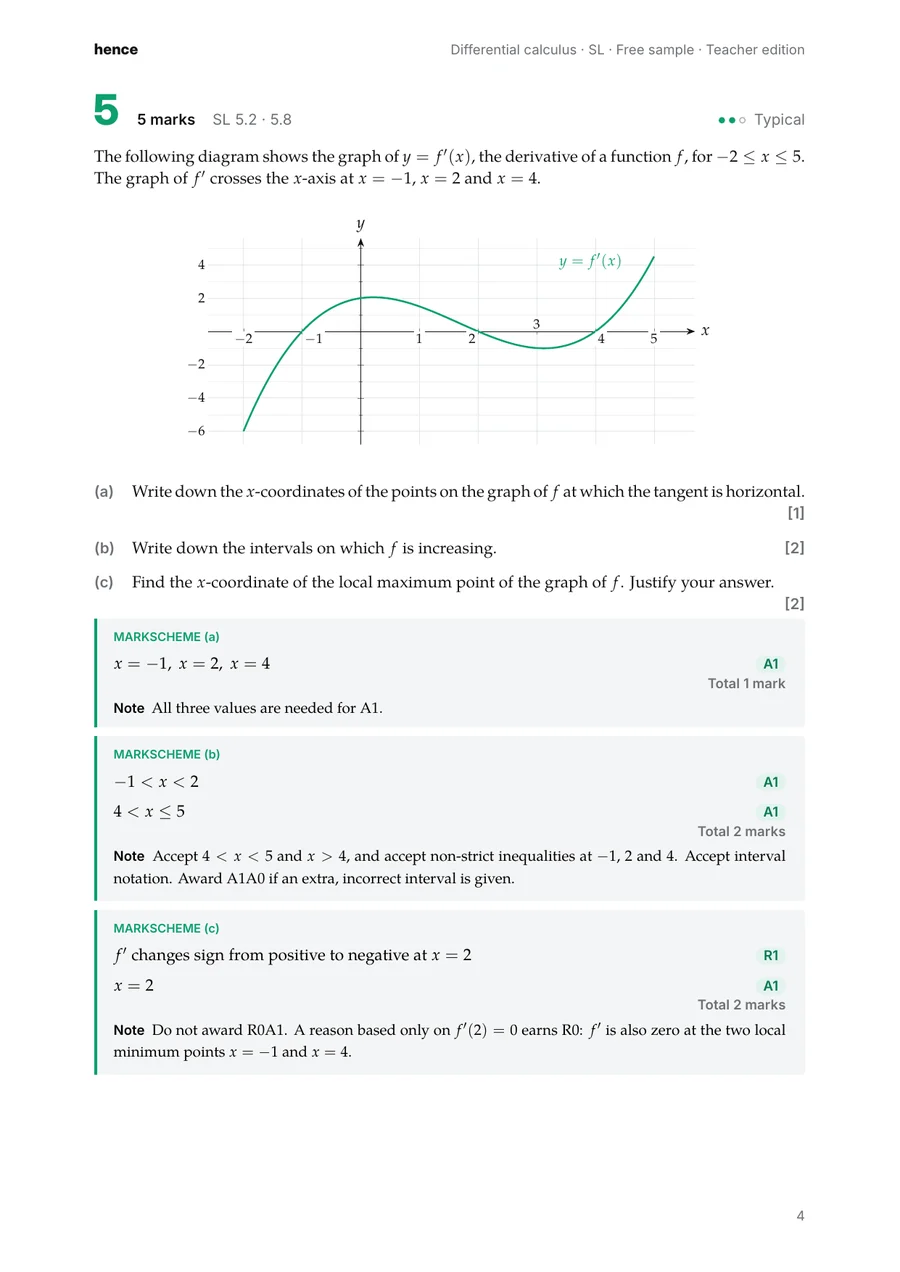
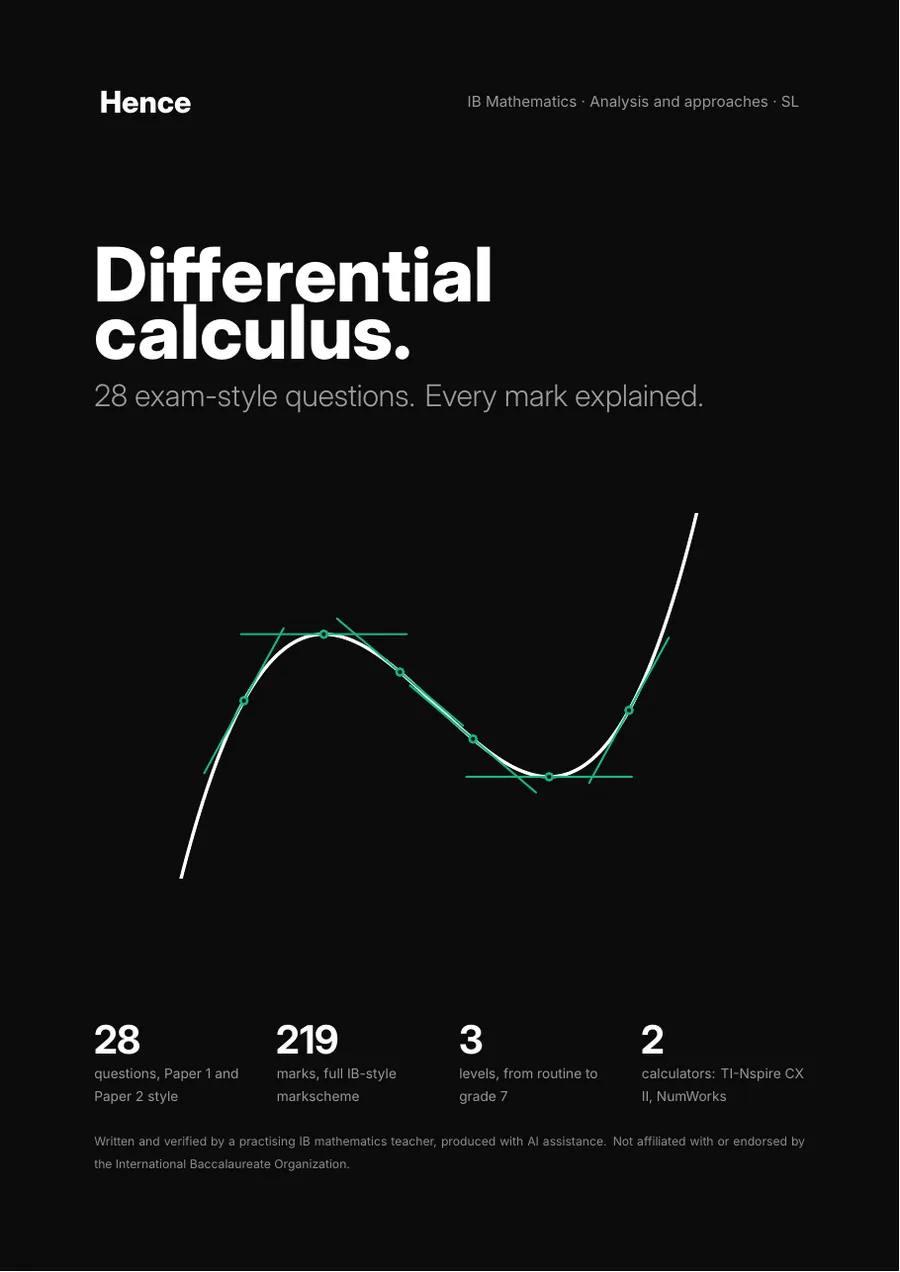
A teacher page: the markscheme of a question, mark by mark Cover of the Differential calculus pack

for teachers

Differential calculus.

Four papers' worth of differentiation from the SL core, which is also part of HL: rates of change, tangents and normals, the chain, product and quotient rules, stationary points, concavity, optimisation and kinematics.

  • 28 questions and 219 marks, sized like real Paper 1 and Paper 2 sections
  • A markscheme in IB conventions, with the alternative methods
  • Key sequences on both calculators for every Paper 2 question
  • A student edition, and a teacher edition in PDF and Word
Student editionanswer spaces, final answers€12
Teacher editionPDF and Word, full markscheme€29
Departmentevery pack, every teacher in one school€249

On sale from December 2026. Six of the questions are free now.