A probability is a proportion of outcomes. Everything on this topic comes from three ideas: count carefully (a Venn diagram, a table, a tree), do not count the overlap twice, and when a condition is given, shrink the universe to it.
IEvents and probabilitiesSL 4.5 · outcomes, sample space, $P(A')$, expected number
I.1 The probability of an event
probability of an event
A letter is chosen at random from the word PROBABILITY. Find $P(\text{B})$, $P(\text{a vowel})$ and $P(\text{not B})$.
Apply
- A card from $1$ to $20$: $P(\text{a multiple of }3)$.
Answer
$\frac{6}{20}=\frac3{10}$ - $P(A)=0.42$: find $P(A')$.
Answer
$0.58$
I.2 The expected number
The probability that an item is faulty is $0.04$. How many faulty items are expected in a batch of $250$?
Apply
- A fair die is thrown $90$ times: the expected number of sixes.
Answer
$15$ - $P(A)=0.07$, $30$ trials: the expected number.
Answer
$2.1$
IICombined eventsSL 4.6 · $A\cup B$, $A\cap B$, Venn diagrams, tree diagrams, mutually exclusive events
II.1 The addition rule
the addition rule
$P(A)=0.45$, $P(B)=0.35$ and $P(A\cap B)=0.15$. Find $P(A\cup B)$ and the probability of neither.
Apply
- $P(A)=0.6$, $P(B)=0.25$, mutually exclusive: $P(A\cup B)$.
Answer
$0.85$ - $P(A\cup B)=0.9$, $P(A)=0.5$, $P(B)=0.6$: $P(A\cap B)$.
Answer
$0.2$
II.2 Venn diagrams
Of $60$ people, $35$ drink tea, $28$ drink coffee and $15$ drink both. Complete a Venn diagram and find the probability that a person drinks exactly one of them.
Apply
- $30$ students, $18$ French, $12$ Spanish, $5$ both: how many take neither?
Answer
$5$ - Same students: $P(\text{Spanish only})$.
Answer
$\frac7{30}$
II.3 Tree diagrams
tree diagrams
A spinner lands on red with probability $0.3$. It is spun twice. Find $P(\text{both red})$ and $P(\text{exactly one red})$.
Apply
- A fair coin is thrown $3$ times: $P(\text{three heads})$.
Answer
$\frac18$ - The spinner of Example 5: $P(\text{at least one red})$.
Answer
$1-0.49=0.51$
II.4 Without replacement
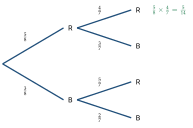
A bag has $7$ white and $2$ black balls. Two are taken without replacement. Find $P(\text{both black})$ and $P(\text{one of each})$.
Apply
- $3$ boys and $4$ girls; two chosen at random: $P(\text{both girls})$.
Answer
$\frac47\times\frac36=\frac27$
IIIConditional probability and independenceSL 4.11 · $P(A\mid B)$, independent events
III.1 Conditional probability
conditional probability
Of $100$ students, $45$ walk to school, and $18$ of those are late; $30$ students are late in all. Find $P(\text{late}\mid\text{walk})$ and $P(\text{walk}\mid\text{late})$.
Apply
- $P(A\cap B)=0.18$, $P(B)=0.6$: $P(A\mid B)$.
Answer
$0.3$ - Example 4's people: $P(\text{coffee}\mid\text{tea})$.
Answer
$\frac{15}{35}=\frac37$
III.2 Conditional probability from a tree
$60\,\%$ of days are dry. A bus is late with probability $0.1$ on a dry day and $0.3$ on a wet day. Find $P(\text{late})$ and $P(\text{wet}\mid\text{late})$.
Apply
- $30\,\%$ of items come from machine $A$ ($5\,\%$ faulty), the rest from $B$ ($2\,\%$ faulty). $P(\text{faulty})$ and $P(A\mid\text{faulty})$.
Answer
$0.029$; $0.517$
III.3 Independent events
independent events
$P(A)=0.3$, $P(B)=0.6$ and $P(A\cap B)=0.18$. Are $A$ and $B$ independent?
Apply
- $P(A)=0.5$, $P(B)=0.4$, $P(A\cup B)=0.75$: independent?
Answer
no: $P(A\cap B)=0.15\ne0.2$ - Independent, $P(A)=0.2$, $P(B)=0.7$: $P(A\cup B)$.
Answer
$0.76$
IVExam-style questionsfrom the shortest to the longest · every one in steps, with its marks
A Without replacement
A bag contains $5$ red counters and $3$ blue counters. Two counters are taken at random, one after the other, without replacement.
Working (a)
Working (b)
Working (c)
B Venn diagrams and independence
In a class of $40$ students, $22$ play football ($F$), $15$ play tennis ($T$) and $6$ play both.
Working (a)
Working (b)
Working (c)
Working (d)
Events $A$ and $B$ are such that $P(A)=0.4$, $P(B)=0.5$ and $P(A\cup B)=0.7$.
Working (a)
Working (b)
Working (c)
C A tree in context (Paper 2)
In a town, $35\,\%$ of the people have been vaccinated ($V$). The probability of catching a cold ($C$) in winter is $0.25$ for a vaccinated person and $0.6$ for a person who has not been vaccinated.
Working (a)
Working (b)
Working (c)
VWhich method? Read the questionthe whole topic on one page
command terms