Every question on calculus starts here: a derivative found quickly and without a slip. Three families of rules, each with its trap: powers (rewrite first), functions of a function (multiply by the inner derivative), products and quotients (two terms, in the right order). Each part ends with exam-style questions, marked line by line.
IPowers, sums and multiplesSL 5.3 · the derivative of $x^{n}$, term by term
I.1 The power rule
the power rule
Differentiate $y=2x^{5}-3x^{2}+7x-4$.
Apply
- $y=x^{4}-5x$
Answer
$4x^{3}-5$ - $y=6-\dfrac{x^{3}}{3}$
Answer
$-x^{2}$ - $y=7$
Answer
$0$
I.2 Rewrite as powers first
rewrite first
Differentiate $y=\dfrac{4}{x^{3}}+8\sqrt x$.
Apply
- $y=\dfrac1x$
Answer
$-\dfrac1{x^{2}}$ - $y=3x^{\frac23}$
Answer
$2x^{-\frac13}$ - $y=\dfrac{x^{4}+3x}{x}$
Answer
$3x^{2}$
I.3 The gradient at a point
Let $f(x)=x^{3}-6x$. Find the gradient of the graph at $x=2$, and the values of $x$ where the gradient is $0$.
Apply
- $y=x^{2}+\dfrac4x$: the gradient at $x=2$.
Answer
$3$ - $f(x)=x^{3}-12x$: where is $f'(x)=0$?
Answer
$x=\pm2$
IIStandard derivatives and the chain ruleSL 5.6 · sin, cos, exponential, logarithm, and a function of a function
II.1 $\sin$, $\cos$, $\mathrm{e}^{x}$, $\ln x$
the standard derivatives
Differentiate $y=3\sin x-2\,\mathrm{e}^{x}+5\ln x$.
Apply
- $y=\cos x+x^{2}$
Answer
$-\sin x+2x$ - $y=4\ln x-\mathrm{e}^{x}$
Answer
$\dfrac4x-\mathrm{e}^{x}$
II.2 The chain rule: $(ax+b)^{n}$, $\mathrm{e}^{kx}$, $\sin kx$
the chain rule
Differentiate $y=(2x+3)^{4}$ and $y=\mathrm{e}^{-5x}$.
Apply
- $y=(1-x)^{6}$
Answer
$-6(1-x)^{5}$ - $y=\mathrm{e}^{\frac x2}$
Answer
$\frac12\mathrm{e}^{\frac x2}$ - $y=\sin3x$
Answer
$3\cos3x$
II.3 The chain rule with any inner function
Differentiate $y=\sqrt{x^{2}+5}$.
Apply
- $y=\ln\left(x^{2}+4\right)$
Answer
$\dfrac{2x}{x^{2}+4}$ - $y=\mathrm{e}^{x^{3}}$
Answer
$3x^{2}\mathrm{e}^{x^{3}}$ - $y=\left(x^{3}+1\right)^{5}$
Answer
$15x^{2}\left(x^{3}+1\right)^{4}$
II.4 An exact gradient
Let $f(x)=2\sin3x$. Find the exact gradient of the graph at $x=\dfrac{\pi}{9}$.
Apply
- $f(x)=\cos2x$: the gradient at $x=\frac{\pi}{4}$.
Answer
$-2$ - $f(x)=\mathrm{e}^{2x}$: the gradient at $x=\ln3$.
Answer
$18$
IIIProducts and quotientsSL 5.6 · the product rule, the quotient rule, and a table of values
III.1 The product rule
the product rule
Differentiate $y=x^{3}\,\mathrm{e}^{2x}$.
Apply
- $y=x\sin x$
Answer
$\sin x+x\cos x$ - $y=(x+1)\ln x$
Answer
$\ln x+\dfrac{x+1}{x}$
III.2 The quotient rule
the quotient rule
Differentiate $y=\dfrac{3x-1}{x+4}$.
Apply
- $y=\dfrac{x^{2}}{x-1}$
Answer
$\dfrac{x^{2}-2x}{(x-1)^{2}}$ - $y=\dfrac{\mathrm{e}^{x}}{x}$
Answer
$\dfrac{\mathrm{e}^{x}(x-1)}{x^{2}}$
III.3 Derivatives from a table of values
$f(3)=2$, $f'(3)=4$, $g(3)=-1$, $g'(3)=5$. Find $h'(3)$ for $h=fg$, and $k'(3)$ for $k=\dfrac fg$.
Apply
- Same values: $m(x)=\big(f(x)\big)^{2}$, find $m'(3)$.
Answer
$2\times2\times4=16$ - Same values: $n(x)=3f(x)-g(x)$, find $n'(3)$.
Answer
$7$
III.4 Gradients on the GDC
Let $f(x)=\ln\left(x^{2}+1\right)-0.5x$. Find $f'(3)$, and the values of $x$ where $f'(x)=0$.
Apply
- $f(x)=x\sin x$: $f'(2)$.
Answer
$0.0770$
IVExam-style questionsfrom the shortest to the longest · every one in steps, with its marks
A Powers
Let $f(x)=4x^{3}-\dfrac{6}{x}+5\sqrt{x}$, for $x\gt 0$.
Working (a)
Working (b)
Let $f(x)=\dfrac{x^{2}-4x+9}{x}$, for $x\neq0$.
Working (a)
Working (b)
B The chain rule
Find $\dfrac{\mathrm{d}y}{\mathrm{d}x}$ for each of the following.
Working (a)
Working (b)
Working (c)
Let $f(x)=3\sin 2x+\cos 4x$, where $x$ is in radians.
Working (a)
Working (b)
C Products, quotients and tables
Let $f(x)=x^{3}\ln x$, for $x\gt 0$.
Working (a)
Working (b)
Let $f(x)=\dfrac{2x+1}{x-3}$, for $x\neq3$.
Working (a)
Working (b)
Working (c)
The table shows values of the functions $f$ and $g$ and of their derivatives at $x=1$ and $x=2$.
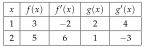
Working (a)
Working (b)
Working (c)
D With the GDC (Paper 2)
Let $f(x)=\left(x^{2}+1\right)\mathrm{e}^{-0.4x}$, for $0\le x\le8$.
Working (a)
Working (b)
Working (c)
Let $f(x)=\sin\left(x^{2}\right)$, for $0\le x\le2.5$, where $x$ is in radians.
Working (a)
Working (b)
VWhich method? Read the questionthe whole topic on one page
command terms