AA HL · Differential calculus · course

The graphs of f, f′ and f″.

AA HL resourcesPDF

Three graphs tell one story. The sign of $f'$ says where $f$ rises and falls; its zeros are the turning points; the sign of $f''$ says which way the graph bends. Exam questions give one graph or one formula and ask about another: this course reads each graph from the next.

IIncreasing and decreasingSL 5.2 · the sign of $f'$

I.1 The sign of $f'$

Definition 1

increasing, decreasing

$f$ is increasing where $f'(x)\gt 0$: the graph rises from left to right; decreasing where $f'(x)\lt 0$. Where $f'(x)=0$, the tangent is horizontal.
Example 1

Let $f(x)=x^{2}-8x+3$. Find where $f$ is decreasing and where it is increasing.

What you do
What you write
Step 1 Differentiate
$f'(x)=2x-8$
Step 2 Solve $f'(x)\lt 0$
$x\lt 4$: decreasing
Step 3 And $f'(x)\gt 0$
$x\gt 4$: increasing
Figure 1 — Where $f'\gt 0$ the graph rises; where $f'\lt 0$ it falls.

Apply

  1. $f(x)=5-3x$: where is $f$ decreasing?
    Answereverywhere: $f'(x)=-3\lt 0$
  2. $f(x)=x^{3}+2x$: where is $f$ increasing?
    Answereverywhere: $3x^{2}+2\gt 0$

I.2 A sign table

Property 1

a sign table

Factorise $f'(x)$, find its zeros, give the sign of $f'$ on each interval between them. The answer is an interval of $x$.
Watch out 1
The interval is a set of values of $x$, never of $y$, with strict inequalities: $-2\lt x\lt 1$.
Example 2

Let $f(x)=x^{3}-3x^{2}-24x$. Find the values of $x$ for which $f$ is decreasing.

What you do
What you write
Step 1 Differentiate, factorise
$f'(x)=3x^{2}-6x-24=3(x-4)(x+2)$
Step 2 Zeros of $f'$
$x=-2$ and $x=4$
Step 3 Sign between the zeros
$f'(0)=-24\lt 0$
Step 4 Write the interval
$-2\lt x\lt 4$

Apply

  1. $f(x)=2x^{3}-9x^{2}+12x$: where is $f$ increasing?
    Answer$x\lt 1$ or $x\gt 2$
  2. $f(x)=x^{3}-27x$: where is $f$ decreasing?
    Answer$-3\lt x\lt 3$

I.3 A factor that is always positive

Example 3

Let $f(x)=x^{2}\,\mathrm{e}^{x}$. Find where $f$ is decreasing.

What you do
What you write
Step 1 Product rule, factorise
$f'(x)=(x^{2}+2x)\,\mathrm{e}^{x}=x(x+2)\,\mathrm{e}^{x}$
Step 2 $\mathrm{e}^{x}\gt 0$: the other factors decide
sign of $x(x+2)$
Step 3 Write the interval
$-2\lt x\lt 0$

Apply

  1. $f(x)=(x+3)\,\mathrm{e}^{-x}$: where is $f$ increasing?
    Answer$f'(x)=-(x+2)\mathrm{e}^{-x}$: $x\lt -2$

IIFrom one graph to the otherSL 5.2 · SL 5.7 · the graph of $f'$ read on $f$, and $f$ read on $f'$

II.1 Reading $f'$ on the graph of $f$

Property 2

reading $f'$ on the graph of $f$

Where $f$ rises, $f'$ is above the axis; where $f$ falls, below. The turning points of $f$ are the zeros of $f'$; the steepest points of $f$ are the maximum and minimum of $f'$.
Example 4

The graph of $f$ has a local maximum at $(-1,\,4)$ and a local minimum at $(2,\,-5)$, and no other turning point. Write down $f'(-1)$, where $f'(x)\lt 0$, and the sign of $f'(3)$.

What you do
What you write
Step 1 Turning point: $f'=0$
$f'(-1)=0$
Step 2 Falling between the turning points
$-1\lt x\lt 2$
Step 3 Rising after the minimum
$f'(3)\gt 0$

Apply

  1. $f$ has only a minimum, at $(3,\,1)$: where is $f'(x)\gt 0$?
    Answer$x\gt 3$
  2. Same $f$: the sign of $f'(0)$.
    Answernegative

II.2 Reading $f$ on the graph of $f'$

Property 3

reading $f$ on the graph of $f'$

$f$ has a local maximum where $f'$ changes from $+$ to $-$, a local minimum where it changes from $-$ to $+$. Where the graph of $f'$ only touches the axis, $f$ has a stationary point that is neither.
Watch out 2
A maximum of the graph of $f'$ is not a maximum of $f$: it is where $f$ rises fastest, a point of inflexion of $f$.
Example 5

The graph of $f'$ crosses the $x$-axis from positive to negative at $x=-3$, from negative to positive at $x=1$, and has its minimum at $x=-1$. Describe the graph of $f$ at these three values.

What you do
What you write
Step 1 $+$ to $-$
$x=-3$: local maximum of $f$
Step 2 $-$ to $+$
$x=1$: local minimum of $f$
Step 3 A turning point of $f'$
$x=-1$: point of inflexion of $f$
Figure 2 — The sign of $f'$ is the direction of $f$.

Apply

  1. $f'(x)=(x-1)^{2}(x+4)$: the nature of each stationary point of $f$.
    Answer$x=-4$ minimum; $x=1$ neither

IIIConcavity and the second derivativeSL 5.7 · the sign of $f''$, points of inflexion

III.1 Concavity: the sign of $f''$

Definition 2

second derivative

The second derivative $f''(x)$, or $\dfrac{\mathrm{d}^{2}y}{\mathrm{d}x^{2}}$, is the derivative of $f'(x)$: the rate of change of the gradient.
Definition 3

concavity

$f''(x)\gt 0$: the graph is concave up (a cup, above its tangents). $f''(x)\lt 0$: concave down (below its tangents).
Example 6

Let $f(x)=x^{3}-9x^{2}+2$. Find where the graph of $f$ is concave up.

What you do
What you write
Step 1 Differentiate twice
$f'(x)=3x^{2}-18x$, $f''(x)=6x-18$
Step 2 Solve $f''(x)\gt 0$
$x\gt 3$
Figure 3 — Concave up: the curve stays above its tangent.

Apply

  1. $f(x)=x^{4}-6x^{2}$: where is it concave down?
    Answer$-1\lt x\lt 1$
  2. $f(x)=\mathrm{e}^{x}+x^{2}$: where is it concave up?
    Answereverywhere: $f''(x)=\mathrm{e}^{x}+2\gt 0$

III.2 Points of inflexion

Property 4

point of inflexion

A point of inflexion: the concavity changes, $f''(x)$ changes sign. Solve $f''(x)=0$, then check the change of sign; $f'$ has a maximum or minimum there.
Watch out 3
$f''(a)=0$ is not enough: write the reason, “$f''$ changes sign”.
Example 7

Let $f(x)=x^{3}+6x^{2}-5$. Find the point of inflexion of its graph.

What you do
What you write
Step 1 Solve $f''(x)=0$
$6x+12=0$: $x=-2$
Step 2 Check the change of sign
$f''\lt 0$ for $x\lt -2$, $\gt 0$ for $x\gt -2$
Step 3 $y$ from $f$
$(-2,\,11)$

Apply

  1. $f(x)=2x^{3}-3x^{2}$: the point of inflexion.
    Answer$\left(\frac12,\,-\frac12\right)$
  2. $f(x)=x^{4}+1$: a point of inflexion at $x=0$?
    Answerno: $f''(x)=12x^{2}$ does not change sign

III.3 On the GDC

Example 8

Let $f(x)=\ln\left(x^{2}+1\right)-0.8x$. Find where $f$ is decreasing, and the point of inflexion with $x\gt 0$.

What you do
What you write
Step 1 Graph $f'$; its zeros
$x=0.5$ and $x=2$
Step 2 $f$ decreasing where $f'\lt 0$
$x\lt 0.5$ or $x\gt 2$
Step 3 Inflexion: the maximum of $f'$
$x=1$: $(1,\,-0.107)$

Apply

  1. $g'(x)=2\cos x-x$, $0\le x\le2$: where is $g$ increasing?
    Answer$0\le x\lt 1.03$

IVExam-style questionsfrom the shortest to the longest · every one in steps, with its marks

A Increasing and decreasing

Exam-style question 1Paper 1 · no calculator · [Maximum mark: 5]

Let $f(x)=2x^{3}+3x^{2}-12x+4$.

(a)Find $f'(x)$.[2]
(b)Find the values of $x$ for which $f$ is decreasing.[3]
More questions like this

Working (a)

What you do
What you write
Step 1 Differentiate
$f'(x)=6x^{2}+6x-12$
A1 for two correct terms.

Working (b)

What you do
What you write
Step 1 Solve $f'(x)\lt 0$, factorised
$6x^{2}+6x-12\lt 0$, $6(x+2)(x-1)\lt 0$
Decreasing: $f'(x)\lt 0$. Factorise to find the zeros.
Step 2 Zeros of $f'$
zeros $x=-2$ and $x=1$
Step 3 Write the interval
$-2\lt x\lt 1$
Between the zeros: $f'$ is a parabola opening upwards, negative between its roots.

Play this question in Mark it: find each mark yourself →

Exam-style question 2Paper 1 · no calculator · [Maximum mark: 4]

Let $f(x)=x\,\mathrm{e}^{-x}$.

(a)Show that $f'(x)=(1-x)\,\mathrm{e}^{-x}$.[2]
(b)Find the values of $x$ for which $f$ is increasing.[2]
More questions like this

Working (a)

What you do
What you write
Step 1 Product rule
product rule: $f'(x)=1\times\mathrm{e}^{-x}+x\times\left(-\mathrm{e}^{-x}\right)$
M1 for the product rule, A1 for $\left(\mathrm{e}^{-x}\right)'=-\mathrm{e}^{-x}$.
$=(1-x)\,\mathrm{e}^{-x}$

Working (b)

What you do
What you write
Step 1 $\mathrm{e}^{-x}\gt 0$: the other factor decides
$\mathrm{e}^{-x}\gt 0$, so $f'(x)$ has the sign of $1-x$
The exponential is always positive: only $1-x$ decides the sign.
Step 2 Write the interval
$x\lt 1$
Do not award R0A1.

Play this question in Mark it: find each mark yourself →

B From one graph to the other

Exam-style question 3Paper 1 · no calculator · [Maximum mark: 7]

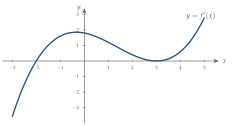
The diagram shows the graph of $y=f'(x)$, the derivative of a function $f$, for $-3\le x\le5$. The graph of $f'$ crosses the $x$-axis at $x=-2$, has a local maximum at $x=-\dfrac13$, and touches the $x$-axis at $x=3$.
the diagram of the question
(a)Write down the $x$-coordinates of the stationary points of the graph of $f$.[2]
(b)Determine the nature of the stationary point at $x=-2$. Justify your answer.[2]
(c)Explain why the graph of $f$ has neither a maximum nor a minimum at $x=3$.[1]
(d)Write down the $x$-coordinates of the points of inflexion of the graph of $f$.[2]
More questions like this

Working (a)

What you do
What you write
Step 1 Zeros of $f'$
$x=-2$
Stationary points of $f$: the zeros of $f'$.
$x=3$

Working (b)

What you do
What you write
Step 1 The change of sign
$f'$ changes from negative to positive at $x=-2$
Step 2 Name it
local minimum
Do not award R0A1.

Working (c)

What you do
What you write
Step 1 $f'$ keeps its sign
$f'$ does not change sign at $x=3$: it is positive on both sides
$f'(3)=0$ alone is not a reason: it says the point is stationary, not what kind.

Working (d)

What you do
What you write
Step 1 Turning points of $f'$
$x=-\dfrac13$
Where $f'$ has a turning point: here its maximum.
$x=3$
The minimum of $f'$: a stationary point of inflexion of $f$.

Play this question in Mark it: find each mark yourself →

Exam-style question 4Paper 1 · no calculator · [Maximum mark: 5]

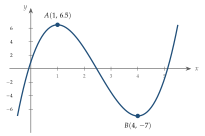
The diagram shows the graph of a cubic function $f$, for $-0.5\le x\le5.5$. The graph has a local maximum at $A(1,\,6.5)$ and a local minimum at $B(4,\,-7)$.
the diagram of the question
(a)Write down the value of $f'(1)$.[1]
(b)Write down the values of $x$ for which $f'(x)\lt 0$.[1]
(c)Write down whether $f'(5)$ is positive or negative.[1]
(d)The graph of $f'$ is a parabola. Find the $x$-coordinate of the point at which the graph of $f$ is decreasing most steeply.[2]
More questions like this

Working (a)

What you do
What you write
Step 1 Turning point: $f'=0$
$0$
A turning point: the tangent is horizontal.

Working (b)

What you do
What you write
Step 1 Where $f$ falls
$1\lt x\lt 4$
Where the graph of $f$ falls.

Working (c)

What you do
What you write
Step 1 Where $f$ rises
positive
$f$ rises after $B$.

Working (d)

What you do
What you write
Step 1 Steepest point: the vertex of $f'$
the minimum of $f'$, at the vertex of the parabola, halfway between its zeros $1$ and $4$
A parabola is symmetric about the vertical line through its vertex.
Step 2 Halfway between $1$ and $4$
$x=2.5$

Play this question in Mark it: find each mark yourself →

C Concavity and points of inflexion

Exam-style question 5Paper 1 · no calculator · [Maximum mark: 6]

Let $f(x)=x^{3}-6x^{2}+5x+2$.

(a)Find $f''(x)$.[2]
(b)Find the values of $x$ for which the graph of $f$ is concave up.[2]
(c)Hence find the coordinates of the point of inflexion of the graph of $f$.[2]
More questions like this

Working (a)

What you do
What you write
Step 1 Differentiate
$f'(x)=3x^{2}-12x+5$
Step 2 Differentiate again
$f''(x)=6x-12$

Working (b)

What you do
What you write
Step 1 Solve $f''(x)\gt 0$
$6x-12\gt 0$
Concave up: $f''(x)\gt 0$.
Step 2 Write the interval
$x\gt 2$

Working (c)

What you do
What you write
Step 1 $f''$ changes sign at $x=2$
$f''$ changes sign at $x=2$
From (b): concave down for $x\lt 2$, up for $x\gt 2$.
Step 2 $y$ from $f$
$(2,\,-4)$
$f(2)=8-24+10+2=-4$, a value of $f$.

Play this question in Mark it: find each mark yourself →

Exam-style question 6Paper 1 · no calculator · [Maximum mark: 6]

Let $f(x)=x^{4}-4x^{3}$.

(a)Find $f''(x)$.[2]
(b)Find the $x$-coordinates of the points of inflexion of the graph of $f$. Justify your answer.[3]
(c)Write down the coordinates of these points.[1]
More questions like this

Working (a)

What you do
What you write
Step 1 Differentiate
$f'(x)=4x^{3}-12x^{2}$
Step 2 Differentiate again
$f''(x)=12x^{2}-24x$

Working (b)

What you do
What you write
Step 1 Solve $f''(x)=0$
$12x(x-2)=0$: $x=0$, $x=2$
Step 2 Check the changes of sign
$f''$ changes sign at each: $+$, then $-$ on $0\lt x\lt 2$, then $+$
Without the change of sign, $x=0$ and $x=2$ are only candidates.
Step 3 Conclude
$x=0$ and $x=2$

Working (c)

What you do
What you write
Step 1 $y$ from $f$
$(0,\,0)$ and $(2,\,-16)$

Play this question in Mark it: find each mark yourself →

D With the GDC (Paper 2)

Exam-style question 7Paper 2 · calculator · [Maximum mark: 6]

Let $f(x)=\mathrm{e}^{0.5x}-x^{2}$, for $0\le x\le6$.

(a)Find $f'(x)$.[2]
(b)Find the values of $x$ for which $f$ is decreasing.[2]
(c)Find the coordinates of the point of inflexion of the graph of $f$.[2]
More questions like this

Working (a)

What you do
What you write
Step 1 Differentiate
$f'(x)=0.5\,\mathrm{e}^{0.5x}-2x$

Working (b)

What you do
What you write
Step 1 Zero of $f'$ on the GDC
$f'(x)\lt 0$; zero of $f'$ at $x=0.289$ ($0.288842\ldots$)
A sketch of $f'$: negative from its zero to the end of the domain.
Step 2 Write the interval
$0.289\lt x\le6$
Accept $0.289\lt x\lt 6$. The other zero of $f'$, $6.52$, is outside the domain.

Working (c)

What you do
What you write
Step 1 $f''=0$, or the minimum of $f'$
$f''(x)=0.25\,\mathrm{e}^{0.5x}-2=0$, or the minimum of the graph of $f'$: $x=4.16$
Exact: $x=2\ln8$.
Step 2 The point
$(4.16,\,-9.30)$
$y=f(4.15888\ldots)=-9.2963\ldots$: a value of $f$.

Play this question in Mark it: find each mark yourself →

Exam-style question 8Paper 2 · calculator · [Maximum mark: 6]

The derivative of a function $g$ is given by $g'(x)=3\sin x-x$, for $0\le x\le3$, where $x$ is in radians.

(a)Find the values of $x$ for which $g$ is increasing.[2]
(b)Find $g''(x)$.[1]
(c)Find the $x$-coordinate of the point of inflexion of the graph of $g$.[3]
More questions like this

Working (a)

What you do
What you write
Step 1 Zeros of $g'$ on the GDC
$g'(x)\gt 0$; zeros of $g'$ at $x=0$ and $x=2.28$ ($2.27886\ldots$)
Plot $g'$ itself: here it is the function given.
Step 2 Write the interval
$0\lt x\lt 2.28$

Working (b)

What you do
What you write
Step 1 Differentiate
$g''(x)=3\cos x-1$

Working (c)

What you do
What you write
Step 1 Solve $g''(x)=0$
$3\cos x-1=0$
Step 2 Compute
$x=1.23$ ($1.23095\ldots$)
Exact: $x=\arccos\frac13$.
Step 3 Check the change of sign
$g''$ changes sign at $x=1.23$ (from positive to negative)
A sketch of $g''$, or the maximum of $g'$ there.

Play this question in Mark it: find each mark yourself →

VWhich method? Read the questionthe whole topic on one page

The question says
You write
You must “find where $f$ is increasing” or decreasing: it is decided by the sign of $f'$.
factorise $f'(x)$; a sign table; an interval of $x$ P1
The derivative comes out as $f'(x)=(\ldots)\,\mathrm{e}^{\ldots}$: $\mathrm{e}^{\ldots}\gt 0$ always.
the sign is decided by the other factor alone; say so D1
The graph of $f$ is given and the questions are about $f'$: where $f$ rises, $f'\gt 0$; at a turning point, $f'=0$.
read the direction of $f$; its steepest point is the max or min of $f'$ P2
The graph of $f'$ is given and the questions are about $f$: look at how $f'$ changes sign, $+$ to $-$, $-$ to $+$, or touches the axis.
maximum, minimum, neither; a turning point of $f'$ is an inflexion of $f$ P3
You must “justify”, or “determine the nature” of a point: the mark is for a reason, written out.
“$f'$ changes from $\ldots$ to $\ldots$”, written before the answer (R1, then A1) P3
You must find where the graph is “concave up” or “concave down”: it is decided by the sign of $f''$.
$f''(x)\gt 0$ or $\lt 0$, an interval of $x$ D3
You must find a “point of inflexion”: $f''=0$ and $f''$ changes sign.
solve $f''(x)=0$, check the change of sign, then $y=f(x)$ P4
On Paper 2, the graph of $f'$ is drawn on the GDC: the GDC is allowed.
on the GDC: intervals from the zeros of $f'$, inflexions from the turning points of $f'$
In the exam 1

command terms

Write down: read on the graph, no working needed. Determine, justify: the reason earns R1, and the answer without it earns nothing. Hence: use the previous part. An interval is a set of values of $x$, with strict inequalities where $f'$ or $f''$ is zero at the ends.