A line is fixed by a point and a gradient; a function by its rule and its domain. The exam reads both from a few numbers: a gradient, an intercept, the values a function cannot take, the values it reaches, the points where two graphs meet.
IStraight linesSL 2.1 · gradient, the three forms, parallel and perpendicular
I.1 The gradient
gradient
Find the gradient of the line through $(-2,\,5)$ and $(4,\,-7)$.
Apply
- The gradient of the line through $(1,\,3)$ and $(5,\,11)$.
Answer
$2$ - The gradient of the line through $(-3,\,4)$ and $(3,\,1)$.
Answer
$-\frac12$ - The gradient of the line through $(2,\,-1)$ and $(2,\,6)$.
Answer
none: the line $x=2$ is vertical
I.2 The equation of a line
three forms of the equation
Find the equation of the line through $(3,\,-1)$ with gradient $4$. Give it in the form $y=mx+c$.
Apply
- Through $(1,\,6)$ with gradient $-3$, in the form $y=mx+c$.
Answer
$y=-3x+9$ - Through $(-1,\,-4)$ and $(1,\,2)$, in the form $y=mx+c$.
Answer
$m=3$; $y=3x-1$ - The gradient and the $y$-intercept of $2x+5y-10=0$.
Answer
$-\frac25$; $2$
I.3 The general form $ax+by+d=0$
Write $y=\dfrac23x-5$ in the form $ax+by+d=0$, where $a,\,b,\,d\in\mathbb{Z}$.
Apply
- Write $y=-\frac14x+2$ in the form $ax+by+d=0$, with integers.
Answer
$x+4y-8=0$ - Write $y=\frac32x+\frac12$ in the form $ax+by+d=0$, with integers.
Answer
$3x-2y+1=0$
I.4 Parallel and perpendicular lines
parallel and perpendicular
The line $L$ has gradient $2$ and passes through $P(2,\,3)$. Find the equation of the line perpendicular to $L$ through $P$.
Apply
- The line parallel to $y=-2x+7$ through $(1,\,4)$.
Answer
$y=-2x+6$ - The line perpendicular to $y=\frac12x+3$ through $(-2,\,5)$.
Answer
$y=-2x+1$ - Are $2x+y=4$ and $x-2y=6$ perpendicular?
Answer
yes: $(-2)\times\frac12=-1$
I.5 Where a line meets the axes
Find the points where the line $2x+5y-20=0$ meets the $x$-axis and the $y$-axis.
Apply
- Where does $4x-3y+24=0$ meet the axes?
Answer
$(-6,\,0)$ and $(0,\,8)$ - Where does $y=-2x+8$ meet the axes?
Answer
$(4,\,0)$ and $(0,\,8)$
IIFunctions, domain and rangeSL 2.2 · 2.4 · the domain, the range, the key features of a graph
II.1 A function: $f(x)$ and $f(x)=k$
function
Let $f(x)=3x^{2}-2$. Find $f(-2)$, then solve $f(x)=25$.
Apply
- $g(x)=5-2x$: find $g(4)$, then solve $g(x)=11$.
Answer
$-3$; $x=-3$ - $h(x)=x^{2}+1$: find $h(-3)$, then solve $h(x)=17$.
Answer
$10$; $x=\pm4$
II.2 The largest possible domain
the largest possible domain
Find the largest possible domain of $f(x)=\sqrt{12-3x}$.
Apply
- Largest domain of $\dfrac1{2x-5}$.
Answer
$x\ne\frac52$ - Largest domain of $\ln(x+6)$.
Answer
$x\gt -6$ - Largest domain of $\sqrt{x+1}+\dfrac1{x-3}$.
Answer
$x\ge-1$, $x\ne3$
II.3 The range on a restricted domain
Find the range of $f(x)=x^{2}+2x-3$, for $-3\le x\le2$.
Apply
- Range of $f(x)=4-x$, for $0\le x\le6$.
Answer
$-2\le f(x)\le4$ - Range of $f(x)=x^{2}-8x+10$, for $0\le x\le5$.
Answer
$-6\le f(x)\le10$ - Range of $f(x)=x^{2}$, for $-2\le x\le3$.
Answer
$0\le f(x)\le9$
II.4 Domain and range of a square root
Let $f(x)=\sqrt{3x-9}+4$, for $x\ge3$. Find the range of $f$, then solve $f(x)=7$.
Apply
- Range of $f(x)=\sqrt{x-4}-1$, for $x\ge4$.
Answer
$f(x)\ge-1$ - Domain and range of $f(x)=2+\sqrt{5-x}$.
Answer
$x\le5$; $f(x)\ge2$ - Solve $\sqrt{x+2}=3$.
Answer
$x=7$
II.5 Key features of a graph
key features of a graph
For $f(x)=x^{2}-2x-8$, write down the $y$-intercept, the zeros and the vertex of the graph.
Apply
- $y=x^{2}-9$: $y$-intercept and zeros.
Answer
$(0,\,-9)$; $x=\pm3$ - $y=\dfrac2{x+1}$: the vertical asymptote and the $y$-intercept.
Answer
$x=-1$; $(0,\,2)$
IIISolving equations with graphsSL 2.3 · 2.10 · zeros and intersections, by hand and on the GDC
III.1 The zeros on the GDC
one equation, two graphs
Solve $x^{3}-4x+2=0$.
Apply
- Solve $x^{3}-2x^{2}-1=0$.
Answer
$x=2.21$ (one zero) - Solve $4-x^{2}=0$, then check on the GDC.
Answer
$x=\pm2$
III.2 Where two graphs meet
Solve $\ln x=3-x$.
Apply
- Solve $2^{x}=5-x$.
Answer
$x=1.72$ - Solve $x^{2}=\mathrm{e}^{x}$.
Answer
$x=-0.703$ - Solve $4-x^{2}=\mathrm{e}^{x}$.
Answer
$x=-1.96$ or $x=1.06$
III.3 An inequality from two graphs
Solve $\mathrm{e}^{0.5x}\gt 3-x$.
Apply
- Solve $2^{x}\lt 5-x$.
Answer
$x\lt 1.72$ - Solve $4-x^{2}\gt \mathrm{e}^{x}$.
Answer
$-1.96\lt x\lt 1.06$
IVExam-style questionsfrom the shortest to the longest · every one in steps, with its marks
A Straight lines
The points $A(-1,\,2)$ and $B(3,\,10)$ lie on the line $L_1$.
The line $L_2$ is perpendicular to $L_1$ and passes through $B$.
Working (a)
Working (b)
Working (c)
The line $L$ has equation $3x-4y+12=0$.
Working (a)
Working (b)
Working (c)
B Domain and range
Let $f(x)=\sqrt{2x-6}+1$, for $x\ge a$, where $a$ is the smallest value for which $f$ is defined.
Working (a)
Working (b)
Working (c)
Let $f(x)=x^{2}-4x+1$, for $-1\le x\le5$.
Working (a)
Working (b)
Working (c)
C With the GDC (Paper 2)
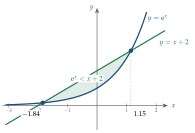
Let $f(x)=\mathrm{e}^{x}$ and $g(x)=x+2$.
Working (a)
Working (b)
Working (c)
Let $f(x)=x^{3}-3x-1$, for $-2\le x\le2$.
Working (a)
Working (b)
VWhich method? Read the questionthe whole topic on one page
command terms