AA HL · Functions and their graphs · course

Quadratic functions.

AA HL resourcesPDF

One parabola, three ways of writing it: each form answers one question. Then the discriminant says, before any solving, how many times the parabola crosses the $x$-axis.

IThe three forms of a quadraticSL 2.6 · $ax^{2}+bx+c$, $a(x-p)(x-q)$, $a(x-h)^{2}+k$

I.1 The expanded form

Definition 1

quadratic function

$f(x)=ax^{2}+bx+c$, with $a\ne0$. Its graph is a parabola: it opens upwards if $a\gt 0$, downwards if $a\lt 0$, and is symmetric about its axis, the vertical line through the vertex.
Property 1

what the expanded form tells

$y=ax^{2}+bx+c$: the $y$-intercept is $c$; the axis of symmetry is $x=-\dfrac{b}{2a}$.
Example 1

Find the axis of symmetry and the vertex of the graph of $y=2x^{2}+12x+7$.

What you do
What you write
Step 1 Read $a$, $b$, $c$
$a=2,\ b=12,\ c=7$
Step 2 Axis: $x=-\dfrac{b}{2a}$Keep the minus sign.
$x=-\dfrac{12}{4}=-3$
Step 3 Substitute to find $y$
$y=2(-3)^{2}+12(-3)+7=-11$
Step 4 Write the vertex as a point
vertex $(-3,\,-11)$

Apply

  1. $y=x^{2}-10x+4$: axis and vertex.
    Answer$x=5$; $(5,\,-21)$
  2. $y=-3x^{2}+6x+1$: axis and vertex.
    Answer$x=1$; $(1,\,4)$
  3. $y=5-4x-x^{2}$: axis, vertex and $y$-intercept.
    Answer$x=-2$; $(-2,\,9)$; $(0,\,5)$

I.2 The factorised form

Property 2

what the factorised form tells

$y=a(x-p)(x-q)$: the zeros are $p$ and $q$; the axis is halfway between them, $x=\dfrac{p+q}{2}$.
Example 2

Find the zeros, the axis of symmetry and the vertex of the graph of $y=3(x+2)(x-4)$.

What you do
What you write
Step 1 Read the zeros from the factors$(x+2)$ gives $x=-2$: the sign changes.
$x=-2$ and $x=4$
Step 2 Axis halfway between the zeros
$x=\dfrac{-2+4}{2}=1$
Step 3 Substitute to find $y$
$y=3(3)(-3)=-27$, vertex $(1,\,-27)$

Apply

  1. $y=-(x-1)(x-7)$: zeros, axis, vertex.
    Answer$1$ and $7$; $x=4$; $(4,\,9)$
  2. $y=2(x+5)(x+1)$: zeros, axis, vertex.
    Answer$-5$ and $-1$; $x=-3$; $(-3,\,-8)$
  3. $y=x(x-6)$: zeros, axis, vertex.
    Answer$0$ and $6$; $x=3$; $(3,\,-9)$

I.3 The vertex form: completing the square

Property 3

what the vertex form tells

$y=a(x-h)^{2}+k$: the vertex is $(h,\,k)$, the axis is $x=h$. To get it when $a=1$: $\displaystyle x^{2}+bx+c=\Big(x+\frac b2\Big)^{2}-\Big(\frac b2\Big)^{2}+c.$
Example 3

Write $x^{2}-6x+5$ in the form $(x-h)^{2}+k$, and give the vertex of its graph.

What you do
What you write
Step 1 Halve $b$
$\dfrac{-6}{2}=-3$
Step 2 Square the bracket, subtract the square
$(x-3)^{2}-9+5$
Step 3 Tidy the constant
$(x-3)^{2}-4$
Step 4 Read the vertex $(h,\,k)$$(x-3)$ gives $h=+3$.
vertex $(3,\,-4)$
Figure 1 — Example 3, $(x-3)^{2}-4$: the vertex $(h,\,k)$ moves the whole parabola.

Apply

  1. Write $x^{2}-4x+9$ in vertex form; give the vertex.
    Answer$(x-2)^{2}+5$; $(2,\,5)$
  2. Write $x^{2}+10x+18$ in vertex form; give the vertex.
    Answer$(x+5)^{2}-7$; $(-5,\,-7)$
  3. Write $x^{2}+3x+1$ in vertex form.
    Answer$\big(x+\frac32\big)^{2}-\frac54$

I.4 Completing the square when $a\ne1$

Watch out 1
Take $a$ out of the $x$ terms only. The square you subtract is inside the bracket: it is multiplied by $a$ too.
Example 4

Write $3x^{2}+18x+20$ in the form $a(x-h)^{2}+k$.

What you do
What you write
Step 1 Take $a$ out of the $x$ terms
$3\left(x^{2}+6x\right)+20$
Step 2 Complete the square inside
$3\left[(x+3)^{2}-9\right]+20$
Step 3 Multiply out by $a$The $-9$ becomes $-27$: this is where marks are lost.
$3(x+3)^{2}-27+20$
Step 4 Tidy the constant
$3(x+3)^{2}-7$, vertex $(-3,\,-7)$

Apply

  1. Write $2x^{2}+8x+3$ in the form $a(x-h)^{2}+k$.
    Answer$2(x+2)^{2}-5$
  2. Write $-x^{2}+6x-4$ in the form $a(x-h)^{2}+k$.
    Answer$-(x-3)^{2}+5$
  3. Write $4x^{2}-8x+1$ in the form $a(x-h)^{2}+k$.
    Answer$4(x-1)^{2}-3$

I.5 Finding the equation from the graph

Example 5

A parabola crosses the $x$-axis at $x=2$ and $x=6$, and the $y$-axis at $(0,\,-36)$. Find its equation.

What you do
What you write
Step 1 Write the factors from the zeros
$y=a(x-2)(x-6)$
Step 2 Substitute the third point
$-36=a(-2)(-6)=12a$
Step 3 Solve for $a$
$a=-3$
Step 4 Write the equation
$y=-3(x-2)(x-6)$

Apply

  1. Zeros $-3$ and $1$, through $(0,\,-12)$.
    Answer$y=4(x+3)(x-1)$
  2. Vertex $(2,\,5)$, through $(4,\,-7)$. Start from $a(x-h)^{2}+k$.
    Answer$y=-3(x-2)^{2}+5$
  3. Zeros $0$ and $4$, through $(2,\,8)$.
    Answer$y=-2x(x-4)$

IIEquations and the discriminantSL 2.7 · the quadratic formula, $\Delta=b^{2}-4ac$ and the number of roots

II.1 The quadratic formula

Property 4

the quadratic formula

The solutions of $ax^{2}+bx+c=0$ are $x=\dfrac{-b\pm\sqrt{b^{2}-4ac}}{2a}$. Factorise first when you can; the formula always works.
Example 6

Solve $2x^{2}-3x-4=0$. Give your answers correct to three significant figures.

What you do
What you write
Step 1 Read $a$, $b$, $c$
$a=2,\ b=-3,\ c=-4$
Step 2 Compute $b^{2}-4ac$ first$-4ac=-4(2)(-4)=+32$.
$9+32=41$
Step 3 Use the formula
$x=\dfrac{3\pm\sqrt{41}}{4}$
Step 4 Round at the very end
$x=2.35$ or $x=-0.851$

Apply

  1. Solve $x^{2}-7x+10=0$.
    Answer$x=2$ or $x=5$
  2. Solve $x^{2}+2x-5=0$, exactly.
    Answer$x=-1\pm\sqrt6$
  3. Solve $3x^{2}+5x-1=0$ (3 s.f.).
    Answer$x=0.180$ or $x=-1.85$

II.2 The discriminant: how many roots

Definition 2

discriminant

$\Delta=b^{2}-4ac$. $\Delta\gt 0$: two distinct real roots; $\Delta=0$: two equal roots, the parabola touches the axis; $\Delta\lt 0$: no real roots.
Example 7

How many real roots does $x^{2}-4x+7=0$ have?

What you do
What you write
Step 1 Read $a$, $b$, $c$
$a=1,\ b=-4,\ c=7$
Step 2 Compute $\Delta$
$\Delta=16-28=-12$
Step 3 Compare $\Delta$ with $0$
$\Delta\lt 0$
Step 4 Conclude in words
no real roots
Figure 2 — Example 7 is $c=7$. As $c$ grows, the two roots close in, merge at $c=4$, then vanish.

Apply

  1. $x^{2}-6x+9=0$: how many real roots?
    Answer$\Delta=0$: two equal roots ($x=3$)
  2. $2x^{2}+x-6=0$: how many real roots?
    Answer$\Delta=49\gt 0$: two distinct real roots
  3. $5x^{2}-2x+1=0$: how many real roots?
    Answer$\Delta=-16\lt 0$: none

II.3 A parameter $k$ in the equation

Watch out 2
Read the words: “two distinct real roots” is $\Delta\gt 0$; “two equal roots” or “touches” is $\Delta=0$; “real roots” is $\Delta\ge0$; “no real roots” or “never meets” is $\Delta\lt 0$.
Example 8

The equation $x^{2}+kx+16=0$ has two equal roots. Find the possible values of $k$.

What you do
What you write
Step 1 Write $\Delta$ with $k$ in it
$\Delta=k^{2}-4(1)(16)=k^{2}-64$
Step 2 Translate the words
equal roots: $k^{2}-64=0$
Step 3 Solve: both signs$k^{2}=64$ has two solutions.
$k=8$ or $k=-8$

Apply

  1. $2x^{2}-4x+k=0$ has two distinct real roots. Find $k$.
    Answer$16-8k\gt 0$, so $k\lt 2$
  2. $x^{2}-2x+k-3=0$ has no real roots. Find $k$.
    Answer$4-4(k-3)\lt 0$, so $k\gt 4$
  3. $x^{2}+(k+1)x+4=0$ has two equal roots. Find $k$.
    Answer$k=3$ or $k=-5$

IIIQuadratic inequalitiesSL 2.7 · solve $ax^{2}+bx+c\gt 0$ with a sketch

III.1 Solving with a sketch

Property 5

solving with a sketch

Find the roots, sketch the parabola, read where it is above ($\gt 0$) or below ($\lt 0$) the $x$-axis. For $a\gt 0$ and roots $p\lt q$: below between the roots, above outside them.
Watch out 3
$x^{2}\gt 9$ is not $x\gt 3$ alone: it is $x\lt -3$ or $x\gt 3$.
Example 9

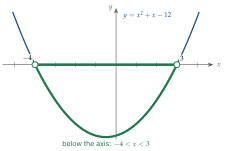
Solve $x^{2}+x-12\lt 0$.

What you do
What you write
Step 1 Solve the equation $=0$
$(x+4)(x-3)=0$: $x=-4$, $x=3$
Step 2 Sketch: $a\gt 0$, opens upwards
the parabola is below the axis between the roots (Figure 3)
Step 3 Read the answer
$-4\lt x\lt 3$
Figure 3 — Example 9: below the $x$-axis exactly for $-4\lt x\lt 3$.

Apply

  1. Solve $x^{2}-9x+14\ge0$.
    Answer$x\le2$ or $x\ge7$
  2. Solve $-x^{2}+4x+12\gt 0$.
    Answer$-2\lt x\lt 6$
  3. Solve $x^{2}\gt 16$.
    Answer$x\lt -4$ or $x\gt 4$

III.2 An inequality for $k$

Example 10

The equation $x^{2}-kx+25=0$ has no real roots. Find the possible values of $k$.

What you do
What you write
Step 1 Write $\Delta$ with $k$ in it
$\Delta=k^{2}-100$
Step 2 Translate: no real roots
$k^{2}-100\lt 0$
Step 3 Solve with a sketch of $k^{2}-100$Between the roots: the parabola in $k$ opens upwards.
$-10\lt k\lt 10$

Apply

  1. $3x^{2}+kx+3=0$ has two distinct real roots. Find $k$.
    Answer$k^{2}-36\gt 0$: $k\lt -6$ or $k\gt 6$
  2. $x^{2}+2kx+9=0$ has no real roots. Find $k$.
    Answer$4k^{2}-36\lt 0$: $-3\lt k\lt 3$

IVExam-style questionsfrom the shortest to the longest · every one in steps, with its marks

A Forms and the vertex

Exam-style question 1Paper 1 · no calculator · [Maximum mark: 6]

Let $f(x)=2x^{2}-8x+5$.

(a)Write $f(x)$ in the form $a(x-h)^{2}+k$.[3]
(b)Write down the coordinates of the vertex of the graph of $f$.[1]
(c)Write down the equation of the axis of symmetry and the $y$-intercept of the graph of $f$.[2]
More questions like this

Working (a)

What you do
What you write
Step 1 Take $a$ out of the $x$ terms
$2\left(x^{2}-4x\right)+5$
Step 2 Complete the square, multiply out by $a$
$2(x-2)^{2}-8+5$
The $-4$ inside the bracket becomes $-8$.
Step 3 Tidy the constant
$f(x)=2(x-2)^{2}-3$

Working (b)

What you do
What you write
Step 1 Read the vertex $(h,\,k)$
$(2,\,-3)$

Working (c)

What you do
What you write
Step 1 Axis: $x=h$
$x=2$
An equation: “$2$” alone is not the axis.
Step 2 $y$-intercept: $f(0)$
$5$

Play this question in Mark it: find each mark yourself →

Exam-style question 2Paper 1 · no calculator · [Maximum mark: 6]

The graph of a quadratic function $f$ crosses the $x$-axis at $(-1,\,0)$ and $(3,\,0)$, and the $y$-axis at $(0,\,6)$.

(a)Find $f(x)$, in the form $a(x-p)(x-q)$.[3]
(b)Find the coordinates of the vertex of the graph of $f$.[2]
(c)Write down the range of $f$.[1]
More questions like this

Working (a)

What you do
What you write
Step 1 Write the factors from the zeros
$f(x)=a(x+1)(x-3)$
Step 2 Substitute the third point $(0,\,6)$
$a(1)(-3)=6$
Step 3 Solve for $a$
$f(x)=-2(x+1)(x-3)$

Working (b)

What you do
What you write
Step 1 Axis halfway between the zeros
$x=\dfrac{-1+3}{2}=1$
Step 2 Substitute to find $y$
$(1,\,8)$

Working (c)

What you do
What you write
Step 1 Read the range from the vertex
$f(x)\le8$
$a\lt 0$: the vertex is the highest point.

Play this question in Mark it: find each mark yourself →

B The discriminant

Exam-style question 3Paper 1 · no calculator · [Maximum mark: 4]

The equation $x^{2}+(k-2)x+4=0$ has two equal real roots.

(a)Find the possible values of $k$.[4]
More questions like this

Working (a)

What you do
What you write
Step 1 Write $\Delta$ with $k$ in it
$\Delta=(k-2)^{2}-4\times1\times4$
Step 2 Equal roots: $\Delta=0$
$(k-2)^{2}-16=0$
Step 3 Take the square root
$k-2=\pm4$
Both signs.
Step 4 Solve for $k$
$k=-2$ or $k=6$

Play this question in Mark it: find each mark yourself →

Exam-style question 4Paper 1 · no calculator · [Maximum mark: 6]

The line $y=mx-1$ meets the curve $y=x^{2}+3$ at exactly one point.

(a)Show that $x^{2}-mx+4=0$.[1]
(b)Find the possible values of $m$.[3]
(c)For the positive value of $m$, find the coordinates of the point where the line meets the curve.[2]
More questions like this

Working (a)

What you do
What you write
Step 1 Equate the two expressions for $y$
$x^{2}+3=mx-1$
Step 2 Rearrange to the given form
$x^{2}-mx+4=0$

Working (b)

What you do
What you write
Step 1 Write $\Delta$ with $m$ in it
$\Delta=m^{2}-16$
Step 2 One point of contact: $\Delta=0$
$m^{2}-16=0$
Step 3 Solve for $m$
$m=\pm4$

Working (c)

What you do
What you write
Step 1 Put $m=4$ in the equation and solve
$x^{2}-4x+4=0\Rightarrow x=2$
Step 2 Find $y$
$(2,\,7)$
$y$ from the line: $4(2)-1=7$.

Play this question in Mark it: find each mark yourself →

C The discriminant and an inequality

Exam-style question 5Paper 1 · no calculator · [Maximum mark: 5]

The equation $kx^{2}-4x+k=0$, where $k\ne0$, has no real roots.

(a)Find the possible values of $k$.[5]
More questions like this

Working (a)

What you do
What you write
Step 1 Write $\Delta$ with $k$ in it
$\Delta=16-4k^{2}$
Step 2 No real roots: $\Delta\lt 0$
$16-4k^{2}\lt 0$
Step 3 Isolate $k^{2}$
$k^{2}\gt 4$
Step 4 Solve with a sketch: outside the roots
$k\lt -2$ or $k\gt 2$
A1 for each inequality; $-2\lt k\lt 2$ earns A0A0.

Play this question in Mark it: find each mark yourself →

D In context, with the GDC (Paper 2)

Exam-style question 6Paper 2 · calculator · [Maximum mark: 6]

A ball is thrown upwards. Its height, in metres, $t$ seconds after it is thrown is $h(t)=-4.9t^{2}+12t+1.5$, for $t\ge0$, until it hits the ground.

(a)Find the maximum height of the ball.[2]
(b)Find the time at which the ball hits the ground.[2]
(c)Find the length of time for which the ball is more than $5$ metres above the ground.[2]
More questions like this

Working (a)

What you do
What you write
Step 1 Find when the vertex is reached: $-\dfrac{b}{2a}$, or the maximum on the GDC
$t=\dfrac{12}{9.8}=1.22\ldots$
Step 2 Height at the vertex
$8.85$ m ($8.84693\ldots$)

Working (b)

What you do
What you write
Step 1 Set $h(t)=0$
$-4.9t^{2}+12t+1.5=0$
Step 2 Solve on the GDC, keep $t\ge0$
$t=2.57$ s ($2.56817\ldots$)
Reject the negative root.

Working (c)

What you do
What you write
Step 1 Set $h(t)=5$ and solve
$-4.9t^{2}+12t+1.5=5$: $t=0.338$ or $t=2.11$
Step 2 Subtract the two times
$2.11-0.338=1.77$ s ($1.77210\ldots$)

Play this question in Mark it: find each mark yourself →

VWhich method? Read the questionthe whole topic on one page

The question says
You write
You must “write in the form $a(x-h)^{2}+k$” a quadratic given as $ax^{2}+bx+c$: complete the square.
take $a$ out, halve $b$, square and subtract P3
You must find “the vertex” or “the axis of symmetry” of a parabola: use $x=-\dfrac b{2a}$, or read $(h,\,k)$ from the vertex form.
the vertex as a point; the axis as $x=\ldots$ P1
The graph shows the zeros $p$ and $q$ and one more point, and you must find the equation of the quadratic: start from $a(x-p)(x-q)$.
the zeros give the factors; one more point gives $a$ P2
You must “solve” $ax^{2}+bx+c=0$, with no GDC: factorise, or use the formula.
$x=\dfrac{-b\pm\sqrt\Delta}{2a}$ P4
The equation has “two equal roots”, or the line “touches” the parabola, or “is a tangent” to it: the discriminant is $\Delta=0$.
an equation in the parameter D2
The equation has “no real roots”, or the line “never meets” the curve: the discriminant is $\Delta\lt 0$.
an inequality in the parameter; a sketch to solve it W2
You must “solve $ax^{2}+bx+c\gt 0$”, an inequality: find the roots, then make a sketch of the parabola.
between the roots, or outside them P5
In the exam 1

command terms

Two distinct real roots: $\Delta\gt 0$. Equal roots: $\Delta=0$. Real roots: $\Delta\ge0$. Show that: every step, ending with the result given. Write down the axis: an equation, $x=\ldots$.