AA SL · Differential calculus · course

Rules of differentiation.

AA SL resourcesPDF

Every question on calculus starts here: a derivative found quickly and without a slip. Three families of rules, each with its trap: powers (rewrite first), functions of a function (multiply by the inner derivative), products and quotients (two terms, in the right order). Each part ends with exam-style questions, marked line by line.

IPowers, sums and multiplesSL 5.3 · the derivative of $x^{n}$, term by term

I.1 The power rule

Property 1

the power rule

For every rational $n$, $\dfrac{\mathrm{d}}{\mathrm{d}x}\left(x^{n}\right)=nx^{n-1}$. A constant has derivative $0$; a sum is differentiated term by term; a constant factor stays.
Example 1

Differentiate $y=2x^{5}-3x^{2}+7x-4$.

What you do
What you write
Step 1 Each term: bring the power down, lower it by one
$2\times5x^{4}$, $-3\times2x$, $7$, $0$
Step 2 Write the derivative
$\dfrac{\mathrm{d}y}{\mathrm{d}x}=10x^{4}-6x+7$
Figure 1 — The gradient at each point traces the graph of $f'$.

Apply

  1. $y=x^{4}-5x$
    Answer$4x^{3}-5$
  2. $y=6-\dfrac{x^{3}}{3}$
    Answer$-x^{2}$
  3. $y=7$
    Answer$0$

I.2 Rewrite as powers first

Property 2

rewrite first

Write every term as a power of $x$ first: $\dfrac{3}{x^{2}}=3x^{-2}$, $\sqrt{x}=x^{\frac12}$, $\dfrac{2}{\sqrt x}=2x^{-\frac12}$, $\dfrac{x^{2}+5}{x}=x+5x^{-1}$.
Watch out 1
A quotient is not differentiated top and bottom: divide first, term by term. $\sqrt x=x^{\frac12}$ has derivative $\dfrac{1}{2\sqrt x}$, not $\dfrac{1}{2x}$.
Example 2

Differentiate $y=\dfrac{4}{x^{3}}+8\sqrt x$.

What you do
What you write
Step 1 Rewrite as powers
$y=4x^{-3}+8x^{\frac12}$
Step 2 Power rule on each term
$-12x^{-4}+4x^{-\frac12}$
Step 3 Back to fractions if wanted
$-\dfrac{12}{x^{4}}+\dfrac{4}{\sqrt x}$

Apply

  1. $y=\dfrac1x$
    Answer$-\dfrac1{x^{2}}$
  2. $y=3x^{\frac23}$
    Answer$2x^{-\frac13}$
  3. $y=\dfrac{x^{4}+3x}{x}$
    Answer$3x^{2}$

I.3 The gradient at a point

Example 3

Let $f(x)=x^{3}-6x$. Find the gradient of the graph at $x=2$, and the values of $x$ where the gradient is $0$.

What you do
What you write
Step 1 Differentiate
$f'(x)=3x^{2}-6$
Step 2 Substitute $x=2$
$f'(2)=6$
Step 3 Solve $f'(x)=0$
$x^{2}=2$: $x=\pm\sqrt2$

Apply

  1. $y=x^{2}+\dfrac4x$: the gradient at $x=2$.
    Answer$3$
  2. $f(x)=x^{3}-12x$: where is $f'(x)=0$?
    Answer$x=\pm2$

IIStandard derivatives and the chain ruleSL 5.6 · sin, cos, exponential, logarithm, and a function of a function

II.1 $\sin$, $\cos$, $\mathrm{e}^{x}$, $\ln x$

Property 3

the standard derivatives

$(\sin x)'=\cos x$, $(\cos x)'=-\sin x$, $\left(\mathrm{e}^{x}\right)'=\mathrm{e}^{x}$, $(\ln x)'=\dfrac1x$ ($x\gt 0$), with $x$ in radians.
Example 4

Differentiate $y=3\sin x-2\,\mathrm{e}^{x}+5\ln x$.

What you do
What you write
Step 1 Each standard derivative, factor kept
$3\cos x$, $-2\,\mathrm{e}^{x}$, $\dfrac5x$
Step 2 Write the derivative
$\dfrac{\mathrm{d}y}{\mathrm{d}x}=3\cos x-2\,\mathrm{e}^{x}+\dfrac5x$

Apply

  1. $y=\cos x+x^{2}$
    Answer$-\sin x+2x$
  2. $y=4\ln x-\mathrm{e}^{x}$
    Answer$\dfrac4x-\mathrm{e}^{x}$

II.2 The chain rule: $(ax+b)^{n}$, $\mathrm{e}^{kx}$, $\sin kx$

Property 4

the chain rule

$y=g(u)$, $u=h(x)$: $\dfrac{\mathrm{d}y}{\mathrm{d}x}=\dfrac{\mathrm{d}y}{\mathrm{d}u}\times\dfrac{\mathrm{d}u}{\mathrm{d}x}$ — the outer derivative, at the inner function, times the inner derivative. So $\left((ax+b)^{n}\right)'=na(ax+b)^{n-1}$, $\left(\mathrm{e}^{kx}\right)'=k\,\mathrm{e}^{kx}$, $\left(\sin kx\right)'=k\cos kx$, $\left(\ln(ax+b)\right)'=\dfrac{a}{ax+b}$.
Watch out 2
The inner derivative is never forgotten: $\left(\mathrm{e}^{3x}\right)'=3\,\mathrm{e}^{3x}$. And $(\cos x)'=-\sin x$: the sign is the other mark most often lost.
Example 5

Differentiate $y=(2x+3)^{4}$ and $y=\mathrm{e}^{-5x}$.

What you do
What you write
Step 1 Outer derivative, inner kept
$4(2x+3)^{3}$ and $\mathrm{e}^{-5x}$
Step 2 Times the inner derivative
$\times2$ and $\times(-5)$
Step 3 Simplify
$8(2x+3)^{3}$ and $-5\,\mathrm{e}^{-5x}$
Figure 2 — Squeezed by $2$, the wave is twice as steep.

Apply

  1. $y=(1-x)^{6}$
    Answer$-6(1-x)^{5}$
  2. $y=\mathrm{e}^{\frac x2}$
    Answer$\frac12\mathrm{e}^{\frac x2}$
  3. $y=\sin3x$
    Answer$3\cos3x$

II.3 The chain rule with any inner function

Example 6

Differentiate $y=\sqrt{x^{2}+5}$.

What you do
What you write
Step 1 Name the inner function
$u=x^{2}+5$, $y=u^{\frac12}$
Step 2 $\dfrac{\mathrm{d}y}{\mathrm{d}u}$ and $\dfrac{\mathrm{d}u}{\mathrm{d}x}$
$\frac12u^{-\frac12}$ and $2x$
Step 3 Multiply, put $u$ back
$\dfrac{x}{\sqrt{x^{2}+5}}$

Apply

  1. $y=\ln\left(x^{2}+4\right)$
    Answer$\dfrac{2x}{x^{2}+4}$
  2. $y=\mathrm{e}^{x^{3}}$
    Answer$3x^{2}\mathrm{e}^{x^{3}}$
  3. $y=\left(x^{3}+1\right)^{5}$
    Answer$15x^{2}\left(x^{3}+1\right)^{4}$

II.4 An exact gradient

Example 7

Let $f(x)=2\sin3x$. Find the exact gradient of the graph at $x=\dfrac{\pi}{9}$.

What you do
What you write
Step 1 Chain rule
$f'(x)=6\cos3x$
Step 2 Substitute
$6\cos\dfrac{\pi}{3}$
Step 3 Exact value
$6\times\dfrac12=3$

Apply

  1. $f(x)=\cos2x$: the gradient at $x=\frac{\pi}{4}$.
    Answer$-2$
  2. $f(x)=\mathrm{e}^{2x}$: the gradient at $x=\ln3$.
    Answer$18$

IIIProducts and quotientsSL 5.6 · the product rule, the quotient rule, and a table of values

III.1 The product rule

Property 5

the product rule

$(uv)'=u'v+uv'$: each function differentiated in turn, the other kept.
Example 8

Differentiate $y=x^{3}\,\mathrm{e}^{2x}$.

What you do
What you write
Step 1 Write $u$, $v$, $u'$, $v'$
$u=x^{3}$, $v=\mathrm{e}^{2x}$, $u'=3x^{2}$, $v'=2\,\mathrm{e}^{2x}$
Step 2 $u'v+uv'$
$3x^{2}\mathrm{e}^{2x}+2x^{3}\mathrm{e}^{2x}$
Step 3 Factorise
$x^{2}\mathrm{e}^{2x}(3+2x)$
Figure 3 — The change of a rectangle’s area gives $u'v+uv'$.

Apply

  1. $y=x\sin x$
    Answer$\sin x+x\cos x$
  2. $y=(x+1)\ln x$
    Answer$\ln x+\dfrac{x+1}{x}$

III.2 The quotient rule

Property 6

the quotient rule

$\left(\dfrac{u}{v}\right)'=\dfrac{u'v-uv'}{v^{2}}$: the derivative of the top comes first.
Watch out 3
$(uv)'$ is not $u'v'$. In the quotient rule, $uv'-u'v$ gives the opposite sign: every mark after it is lost.
Example 9

Differentiate $y=\dfrac{3x-1}{x+4}$.

What you do
What you write
Step 1 Write $u$, $v$, $u'$, $v'$
$u=3x-1$, $v=x+4$, $u'=3$, $v'=1$
Step 2 $\dfrac{u'v-uv'}{v^{2}}$
$\dfrac{3(x+4)-(3x-1)}{(x+4)^{2}}$
Step 3 Simplify the numerator
$\dfrac{13}{(x+4)^{2}}$

Apply

  1. $y=\dfrac{x^{2}}{x-1}$
    Answer$\dfrac{x^{2}-2x}{(x-1)^{2}}$
  2. $y=\dfrac{\mathrm{e}^{x}}{x}$
    Answer$\dfrac{\mathrm{e}^{x}(x-1)}{x^{2}}$

III.3 Derivatives from a table of values

Example 10

$f(3)=2$, $f'(3)=4$, $g(3)=-1$, $g'(3)=5$. Find $h'(3)$ for $h=fg$, and $k'(3)$ for $k=\dfrac fg$.

What you do
What you write
Step 1 Product rule at $x=3$
$h'(3)=4\times(-1)+2\times5=6$
Step 2 Quotient rule at $x=3$
$k'(3)=\dfrac{4\times(-1)-2\times5}{(-1)^{2}}=-14$

Apply

  1. Same values: $m(x)=\big(f(x)\big)^{2}$, find $m'(3)$.
    Answer$2\times2\times4=16$
  2. Same values: $n(x)=3f(x)-g(x)$, find $n'(3)$.
    Answer$7$

III.4 Gradients on the GDC

Example 11

Let $f(x)=\ln\left(x^{2}+1\right)-0.5x$. Find $f'(3)$, and the values of $x$ where $f'(x)=0$.

What you do
What you write
Step 1 Derivative at a point (GDC)
$f'(3)=0.1$
Step 2 Graph $f'$, or write $\dfrac{2x}{x^{2}+1}=0.5$
zeros of $f'$
Step 3 Read them
$x=0.268$ or $x=3.73$

Apply

  1. $f(x)=x\sin x$: $f'(2)$.
    Answer$0.0770$

IVExam-style questionsfrom the shortest to the longest · every one in steps, with its marks

A Powers

Exam-style question 1Paper 1 · no calculator · [Maximum mark: 5]

Let $f(x)=4x^{3}-\dfrac{6}{x}+5\sqrt{x}$, for $x\gt 0$.

(a)Find $f'(x)$.[4]
(b)Find the gradient of the graph of $f$ at the point where $x=1$.[1]
More questions like this

Working (a)

What you do
What you write
Step 1 Rewrite as powers
$-6x^{-1}$ and $5x^{\frac12}$ seen
The rewriting earns its own mark: write it down.
Step 2 Power rule on each term
$f'(x)=12x^{2}+6x^{-2}+\dfrac52x^{-\frac12}$
One A1 for each term. Accept $\dfrac{6}{x^{2}}$ and $\dfrac{5}{2\sqrt x}$.

Working (b)

What you do
What you write
Step 1 Substitute $x=1$
$f'(1)=12+6+\dfrac52=\dfrac{41}{2}$
Accept $20.5$. Follow through from their (a).

Play this question in Mark it: find each mark yourself →

Exam-style question 2Paper 1 · no calculator · [Maximum mark: 5]

Let $f(x)=\dfrac{x^{2}-4x+9}{x}$, for $x\neq0$.

(a)Show that $f'(x)=1-\dfrac{9}{x^{2}}$.[3]
(b)Find the values of $x$ for which $f'(x)=0$.[2]
More questions like this

Working (a)

What you do
What you write
Step 1 Divide term by term
$f(x)=x-4+\dfrac{9}{x}=x-4+9x^{-1}$
Divide each term of the numerator by $x$.
Step 2 Power rule
$f'(x)=1-9x^{-2}$
One A1 for each term. The constant $-4$ disappears.
Step 3 Back to the given form
$=1-\dfrac{9}{x^{2}}$

Working (b)

What you do
What you write
Step 1 Solve $f'(x)=0$
$1-\dfrac{9}{x^{2}}=0$, $x^{2}=9$
Step 2 Both values
$x=3$, $x=-3$
Both values: $x^{2}=9$ has two solutions.

Play this question in Mark it: find each mark yourself →

B The chain rule

Exam-style question 3Paper 1 · no calculator · [Maximum mark: 5]

Find $\dfrac{\mathrm{d}y}{\mathrm{d}x}$ for each of the following.

(a)$y=(1-4x)^{3}$[2]
(b)$y=\mathrm{e}^{x^{2}+1}$[2]
(c)$y=\ln(5x+2)$, for $x\gt -\dfrac25$[1]
More questions like this

Working (a)

What you do
What you write
Step 1 Outer derivative, inner kept
$3(1-4x)^{2}\times(-4)$
The inner derivative is $-4$: the sign matters.
Step 2 Times the inner derivative
$=-12(1-4x)^{2}$

Working (b)

What you do
What you write
Step 1 Outer derivative, inner kept
$\mathrm{e}^{x^{2}+1}\times2x$
Step 2 Times the inner derivative
$=2x\,\mathrm{e}^{x^{2}+1}$
The exponent stays as it is: $\mathrm{e}^{u}$ has derivative $\mathrm{e}^{u}\times u'$.

Working (c)

What you do
What you write
Step 1 $\dfrac{a}{ax+b}$
$\dfrac{5}{5x+2}$

Play this question in Mark it: find each mark yourself →

Exam-style question 4Paper 1 · no calculator · [Maximum mark: 5]

Let $f(x)=3\sin 2x+\cos 4x$, where $x$ is in radians.

(a)Find $f'(x)$.[3]
(b)Show that the gradient of the graph of $f$ at $x=\dfrac{\pi}{6}$ is $3-2\sqrt3$.[2]
More questions like this

Working (a)

What you do
What you write
Step 1 Chain rule on each term
attempt at the chain rule on either term
Step 2 Write the derivative
$f'(x)=6\cos2x-4\sin4x$
One A1 for each term. $(\cos4x)'=-4\sin4x$: two things to remember, the $4$ and the minus.

Working (b)

What you do
What you write
Step 1 Substitute $\dfrac{\pi}{6}$
$f'\left(\dfrac{\pi}{6}\right)=6\cos\dfrac{\pi}{3}-4\sin\dfrac{2\pi}{3}$
Substitute into their $f'(x)$: $2\times\frac{\pi}{6}=\frac{\pi}{3}$ and $4\times\frac{\pi}{6}=\frac{2\pi}{3}$.
Step 2 Exact values
$=6\times\dfrac12-4\times\dfrac{\sqrt3}{2}$
Exact values on Paper 1: $\cos\frac{\pi}{3}=\frac12$, $\sin\frac{2\pi}{3}=\frac{\sqrt3}{2}$.
Step 3 Reach the given form
$=3-2\sqrt3$

Play this question in Mark it: find each mark yourself →

C Products, quotients and tables

Exam-style question 5Paper 1 · no calculator · [Maximum mark: 5]

Let $f(x)=x^{3}\ln x$, for $x\gt 0$.

(a)Show that $f'(x)=x^{2}(3\ln x+1)$.[3]
(b)Find the exact value of $x$ for which $f'(x)=0$.[2]
More questions like this

Working (a)

What you do
What you write
Step 1 Product rule
attempt at the product rule
Step 2 $u'v+uv'$
$f'(x)=3x^{2}\ln x+x^{3}\times\dfrac1x$
$u=x^{3}$, $v=\ln x$: $u'v+uv'$, one A1 for each term.
Step 3 Factorise
$=3x^{2}\ln x+x^{2}=x^{2}(3\ln x+1)$
Factorise $x^{2}$: the answer is given, so the last step is shown.

Working (b)

What you do
What you write
Step 1 $x^{2}\ne0$: solve $3\ln x+1=0$
$x^{2}\gt 0$, so $3\ln x+1=0$, $\ln x=-\dfrac13$
$x^{2}=0$ is rejected: $x\gt 0$.
Step 2 Undo $\ln$
$x=\mathrm{e}^{-\frac13}$
Exact: $0.717$ alone earns A0.

Play this question in Mark it: find each mark yourself →

Exam-style question 6Paper 1 · no calculator · [Maximum mark: 6]

Let $f(x)=\dfrac{2x+1}{x-3}$, for $x\neq3$.

(a)Show that $f'(x)=-\dfrac{7}{(x-3)^{2}}$.[3]
(b)Explain why the graph of $f$ has no horizontal tangent.[1]
(c)Find the equation of the tangent to the graph of $f$ at the point where $x=4$.[2]
More questions like this

Working (a)

What you do
What you write
Step 1 Quotient rule
$\dfrac{2(x-3)-(2x+1)\times1}{(x-3)^{2}}$
M1 for the quotient rule with $u'v$ first; A1 for the correct substitution.
Step 2 Expand the numerator
$=\dfrac{2x-6-2x-1}{(x-3)^{2}}$
Expand the numerator with its brackets: $-(2x+1)=-2x-1$.
Step 3 Simplify
$=-\dfrac{7}{(x-3)^{2}}$

Working (b)

What you do
What you write
Step 1 The numerator is never $0$
$f'(x)\neq0$ for all $x$: the numerator is $-7$
A horizontal tangent needs $f'(x)=0$.

Working (c)

What you do
What you write
Step 1 Point and gradient at $x=4$
$f(4)=9$, $f'(4)=-7$: $y-9=-7(x-4)$
Step 2 Write the equation
$y=-7x+37$

Play this question in Mark it: find each mark yourself →

Exam-style question 7Paper 1 · no calculator · [Maximum mark: 7]

The table shows values of the functions $f$ and $g$ and of their derivatives at $x=1$ and $x=2$.
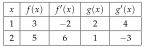
the diagram of the question
(a)Let $h(x)=f(x)\,g(x)$. Find $h'(1)$.[2]
(b)Let $k(x)=f\big(g(x)\big)$. Find $k'(1)$.[3]
(c)Let $m(x)=\dfrac{g(x)}{f(x)}$. Find $m'(2)$.[2]
More questions like this

Working (a)

What you do
What you write
Step 1 Product rule at $x=1$
$h'(1)=f'(1)g(1)+f(1)g'(1)=(-2)(2)+(3)(4)$
The product rule, with the values at $x=1$ read from the table.
Step 2 Compute
$=8$

Working (b)

What you do
What you write
Step 1 Chain rule: $f'$ at $g(1)$
$k'(1)=f'\big(g(1)\big)\times g'(1)$
The chain rule: $f'$ is taken at $g(1)$, not at $1$.
Step 2 Read $f'(2)$
$=f'(2)\times4$
$g(1)=2$: so it is $f'(2)=6$ that is needed.
Step 3 Compute
$=6\times4=24$
$f'(1)\times g'(1)=-8$ is the classic error.

Working (c)

What you do
What you write
Step 1 Quotient rule at $x=2$
$m'(2)=\dfrac{g'(2)f(2)-g(2)f'(2)}{\big(f(2)\big)^{2}}=\dfrac{(-3)(5)-(1)(6)}{25}$
Step 2 Compute
$=-\dfrac{21}{25}$
Accept $-0.84$.

Play this question in Mark it: find each mark yourself →

D With the GDC (Paper 2)

Exam-style question 8Paper 2 · calculator · [Maximum mark: 6]

Let $f(x)=\left(x^{2}+1\right)\mathrm{e}^{-0.4x}$, for $0\le x\le8$.

(a)Find the gradient of the graph of $f$ at the point where $x=2$.[2]
(b)Find the values of $x$ for which $f'(x)=0.5$.[2]
(c)Find the greatest value of $f'(x)$.[2]

Working (a)

What you do
What you write
Step 1 Derivative at $x=2$ on the GDC
use of GDC, or $f'(x)=2x\,\mathrm{e}^{-0.4x}-0.4\left(x^{2}+1\right)\mathrm{e}^{-0.4x}$
$f'(2)=0.899$ ($0.898657\ldots$)

Working (b)

What you do
What you write
Step 1 Graph $f'$ and $y=0.5$: intersections
$x=0.584$ ($0.583993\ldots$)
A sketch of $f'$ and $y=0.5$ shows two intersections.
$x=3.28$ ($3.27988\ldots$)

Working (c)

What you do
What you write
Step 1 Maximum of the graph of $f'$
the maximum of the graph of $f'$, at $x=1.61$
The greatest gradient: the maximum of $f'$, not of $f$.
Step 2 Read the value
$0.936$ ($0.936493\ldots$)

Play this question in Mark it: find each mark yourself →

Exam-style question 9Paper 2 · calculator · [Maximum mark: 5]

Let $f(x)=\sin\left(x^{2}\right)$, for $0\le x\le2.5$, where $x$ is in radians.

(a)Find $f'(x)$.[2]
(b)Find the values of $x$ for which the gradient of the graph of $f$ is $1$.[3]
More questions like this

Working (a)

What you do
What you write
Step 1 Chain rule
$f'(x)=2x\cos\left(x^{2}\right)$
A1 for $\cos\left(x^{2}\right)$, A1 for the factor $2x$.

Working (b)

What you do
What you write
Step 1 Graph $f'$ and $y=1$: intersections
$x=0.519$ ($0.518652\ldots$)
Three intersections of $y=2x\cos(x^{2})$ with $y=1$: a sketch on the GDC shows them all.
$x=1.03$ ($1.03199\ldots$)
$x=2.22$ ($2.22245\ldots$)
Radians: in degrees the graph is a different curve.

Play this question in Mark it: find each mark yourself →

VWhich method? Read the questionthe whole topic on one page

The question says
You write
The function has $\dfrac1{x^{k}}$, $\sqrt x$, or a fraction with one term below: write everything as powers of $x$.
rewrite as $x^{-k}$, $x^{\frac12}$, or divide term by term; then $nx^{n-1}$ P2
The function is $(ax+b)^{n}$, $\mathrm{e}^{\ldots}$, $\sin(\ldots)$ or $\ln(\ldots)$ of something: it is a function of a function, the chain rule.
the outer derivative, at the inner function, times the inner derivative P4
Two functions of $x$ are multiplied, such as $x^{2}\mathrm{e}^{x}$: name them $u$ and $v$, the product rule.
$u'v+uv'$: write $u$, $v$, $u'$, $v'$ first P5
The function is a fraction with $x$ below the line and more than one term: it is $u$ over $v$, the quotient rule.
$\dfrac{u'v-uv'}{v^{2}}$, top derivative first P6
You must “show that $f'(x)=\ldots$”, with the answer given: you know the target, aim for it.
every step; factorise at the end to reach the given form
You must give an “exact value”, or “show that the gradient is $3-2\sqrt3$”: it is Paper 1, no decimals.
exact values: $\frac{\pi}{6}$, $\sqrt3$, $\mathrm{e}$, $\ln2$; no decimals
A table gives values of $f$, $g$, $f'$ and $g'$: you have values only, no formula.
the rule at the point; for $f\big(g(x)\big)$, $f'$ at $g(a)$, not at $a$ P4
You must find “where $f'(x)=k$”, the points with a given gradient: it is an equation in $x$.
solve $f'(x)=k$; every solution in the domain
On Paper 2 you must “find $f'(a)$”, or $f'(x)=k$ is too hard to solve by hand: the GDC is allowed.
on the GDC: the derivative at a point, the graph of $f'$, an intersection
In the exam 1

command terms

Find $f'(x)$: any correct form, simplified or not, unless a form is asked. Show that: every step, the last line is the answer given. Hence: use the previous part. Exact: no decimal, no GDC value. Write down: no working needed.