AA SL · Functions and their graphs · course

Lines, functions and graphs.

AA SL resourcesPDF

A line is fixed by a point and a gradient; a function by its rule and its domain. The exam reads both from a few numbers: a gradient, an intercept, the values a function cannot take, the values it reaches, the points where two graphs meet.

IStraight linesSL 2.1 · gradient, the three forms, parallel and perpendicular

I.1 The gradient

Definition 1

gradient

The gradient of the line through $A(x_1,\,y_1)$ and $B(x_2,\,y_2)$, with $x_1\ne x_2$, is $m=\dfrac{y_2-y_1}{x_2-x_1}$: the rise for one step across. A horizontal line has gradient $0$; a vertical line, $x=k$, has no gradient.
Example 1

Find the gradient of the line through $(-2,\,5)$ and $(4,\,-7)$.

What you do
What you write
Step 1 Label the two points
$(x_1,\,y_1)=(-2,\,5)$, $(x_2,\,y_2)=(4,\,-7)$
Step 2 Rise over runSame order on top and below.
$m=\dfrac{-7-5}{4-(-2)}=\dfrac{-12}{6}$
Step 3 Simplify
$m=-2$

Apply

  1. The gradient of the line through $(1,\,3)$ and $(5,\,11)$.
    Answer$2$
  2. The gradient of the line through $(-3,\,4)$ and $(3,\,1)$.
    Answer$-\frac12$
  3. The gradient of the line through $(2,\,-1)$ and $(2,\,6)$.
    Answernone: the line $x=2$ is vertical

I.2 The equation of a line

Property 1

three forms of the equation

gradient-intercept $y=mx+c$ (gradient $m$, $y$-intercept $c$); point-gradient $y-y_1=m(x-x_1)$, through $(x_1,\,y_1)$; general $ax+by+d=0$, gradient $-\dfrac ab$.
Example 2

Find the equation of the line through $(3,\,-1)$ with gradient $4$. Give it in the form $y=mx+c$.

What you do
What you write
Step 1 Write the point-gradient form
$y-(-1)=4(x-3)$
Step 2 Expand the bracket
$y+1=4x-12$
Step 3 Make $y$ the subject
$y=4x-13$

Apply

  1. Through $(1,\,6)$ with gradient $-3$, in the form $y=mx+c$.
    Answer$y=-3x+9$
  2. Through $(-1,\,-4)$ and $(1,\,2)$, in the form $y=mx+c$.
    Answer$m=3$; $y=3x-1$
  3. The gradient and the $y$-intercept of $2x+5y-10=0$.
    Answer$-\frac25$; $2$

I.3 The general form $ax+by+d=0$

Watch out 1
“In the form $ax+by+d=0$, where $a,\,b,\,d\in\mathbb{Z}$”: clear every fraction, $y=-\frac12x+4$ becomes $x+2y-8=0$. The gradient of $ax+by+d=0$ is $-\frac ab$, not $a$.
Example 3

Write $y=\dfrac23x-5$ in the form $ax+by+d=0$, where $a,\,b,\,d\in\mathbb{Z}$.

What you do
What you write
Step 1 Multiply by the denominator
$3y=2x-15$
Step 2 Bring everything to one sideCheck: the gradient $-\frac{2}{-3}=\frac23$.
$2x-3y-15=0$

Apply

  1. Write $y=-\frac14x+2$ in the form $ax+by+d=0$, with integers.
    Answer$x+4y-8=0$
  2. Write $y=\frac32x+\frac12$ in the form $ax+by+d=0$, with integers.
    Answer$3x-2y+1=0$

I.4 Parallel and perpendicular lines

Property 2

parallel and perpendicular

Gradients $m_1$ and $m_2$: parallel when $m_1=m_2$; perpendicular when $m_1m_2=-1$, that is $m_2=-\dfrac1{m_1}$.
Example 4

The line $L$ has gradient $2$ and passes through $P(2,\,3)$. Find the equation of the line perpendicular to $L$ through $P$.

What you do
What you write
Step 1 Perpendicular gradient: $-\dfrac1m$
$m=-\dfrac12$
Step 2 Point-gradient form through $P$
$y-3=-\dfrac12(x-2)$
Step 3 Make $y$ the subject
$y=-\dfrac12x+4$
Figure 1 — Example 4, through $P(2,\,3)$. The two lines stay perpendicular: $m_1m_2=-1$.

Apply

  1. The line parallel to $y=-2x+7$ through $(1,\,4)$.
    Answer$y=-2x+6$
  2. The line perpendicular to $y=\frac12x+3$ through $(-2,\,5)$.
    Answer$y=-2x+1$
  3. Are $2x+y=4$ and $x-2y=6$ perpendicular?
    Answeryes: $(-2)\times\frac12=-1$

I.5 Where a line meets the axes

Example 5

Find the points where the line $2x+5y-20=0$ meets the $x$-axis and the $y$-axis.

What you do
What you write
Step 1 On the $x$-axis, put $y=0$
$2x-20=0$: $(10,\,0)$
Step 2 On the $y$-axis, put $x=0$
$5y-20=0$: $(0,\,4)$
Step 3 Write both as points
$(10,\,0)$ and $(0,\,4)$

Apply

  1. Where does $4x-3y+24=0$ meet the axes?
    Answer$(-6,\,0)$ and $(0,\,8)$
  2. Where does $y=-2x+8$ meet the axes?
    Answer$(4,\,0)$ and $(0,\,8)$

IIFunctions, domain and rangeSL 2.2 · 2.4 · the domain, the range, the key features of a graph

II.1 A function: $f(x)$ and $f(x)=k$

Definition 2

function

A function $f$ gives each $x$ of its domain exactly one value $f(x)$. The range is the set of the values $f(x)$ takes. On a graph: the domain on the $x$-axis, the range on the $y$-axis.
Example 6

Let $f(x)=3x^{2}-2$. Find $f(-2)$, then solve $f(x)=25$.

What you do
What you write
Step 1 Replace $x$ by $-2$$(-2)^{2}=4$: the bracket keeps the sign.
$f(-2)=3(-2)^{2}-2=10$
Step 2 Write the equation
$3x^{2}-2=25$
Step 3 Solve
$x^{2}=9$: $x=3$ or $x=-3$

Apply

  1. $g(x)=5-2x$: find $g(4)$, then solve $g(x)=11$.
    Answer$-3$; $x=-3$
  2. $h(x)=x^{2}+1$: find $h(-3)$, then solve $h(x)=17$.
    Answer$10$; $x=\pm4$

II.2 The largest possible domain

Property 3

the largest possible domain

Remove what cannot be computed: no division by $0$, no square root of a negative number, no $\ln$ of a number $\le0$.
Example 7

Find the largest possible domain of $f(x)=\sqrt{12-3x}$.

What you do
What you write
Step 1 Spot what can fail
a square root: what is under it must be $\ge0$
Step 2 Write the condition
$12-3x\ge0$
Step 3 Solve itDividing by $-3$ turns the sign round.
$x\le4$

Apply

  1. Largest domain of $\dfrac1{2x-5}$.
    Answer$x\ne\frac52$
  2. Largest domain of $\ln(x+6)$.
    Answer$x\gt -6$
  3. Largest domain of $\sqrt{x+1}+\dfrac1{x-3}$.
    Answer$x\ge-1$, $x\ne3$

II.3 The range on a restricted domain

Watch out 2
The range is not always between $f(a)$ and $f(b)$: a vertex, a maximum or a minimum inside the domain gives the least or the greatest value.
Example 8

Find the range of $f(x)=x^{2}+2x-3$, for $-3\le x\le2$.

What you do
What you write
Step 1 Find the vertex
$x=-\dfrac{2}{2}=-1$, $f(-1)=-4$
Step 2 Compute the ends
$f(-3)=0$, $f(2)=5$
Step 3 Least and greatest of theseThe least value is at the vertex, not at an end.
$-4\le f(x)\le5$
Figure 2 — Exam-style question 4. As $x$ sweeps the domain, $f(x)$ paints the range on the $y$-axis.

Apply

  1. Range of $f(x)=4-x$, for $0\le x\le6$.
    Answer$-2\le f(x)\le4$
  2. Range of $f(x)=x^{2}-8x+10$, for $0\le x\le5$.
    Answer$-6\le f(x)\le10$
  3. Range of $f(x)=x^{2}$, for $-2\le x\le3$.
    Answer$0\le f(x)\le9$

II.4 Domain and range of a square root

Example 9

Let $f(x)=\sqrt{3x-9}+4$, for $x\ge3$. Find the range of $f$, then solve $f(x)=7$.

What you do
What you write
Step 1 The root is never negative
$\sqrt{3x-9}\ge0$
Step 2 Add the constant
$f(x)\ge4$
Step 3 Isolate the root, then square
$\sqrt{3x-9}=3$: $3x-9=9$
Step 4 Solve
$x=6$

Apply

  1. Range of $f(x)=\sqrt{x-4}-1$, for $x\ge4$.
    Answer$f(x)\ge-1$
  2. Domain and range of $f(x)=2+\sqrt{5-x}$.
    Answer$x\le5$; $f(x)\ge2$
  3. Solve $\sqrt{x+2}=3$.
    Answer$x=7$

II.5 Key features of a graph

Property 4

key features of a graph

The $y$-intercept $f(0)$; the zeros, where $f(x)=0$; the vertex, local maximum and minimum points; the lines of symmetry; the vertical and horizontal asymptotes. A sketch shows each with its coordinates.
Example 10

For $f(x)=x^{2}-2x-8$, write down the $y$-intercept, the zeros and the vertex of the graph.

What you do
What you write
Step 1 $y$-intercept: $f(0)$
$(0,\,-8)$
Step 2 Zeros: factorise $f(x)=0$
$(x-4)(x+2)=0$: $x=4$, $x=-2$
Step 3 Vertex halfway between the zeros
$x=1$, $f(1)=-9$: $(1,\,-9)$

Apply

  1. $y=x^{2}-9$: $y$-intercept and zeros.
    Answer$(0,\,-9)$; $x=\pm3$
  2. $y=\dfrac2{x+1}$: the vertical asymptote and the $y$-intercept.
    Answer$x=-1$; $(0,\,2)$

IIISolving equations with graphsSL 2.3 · 2.10 · zeros and intersections, by hand and on the GDC

III.1 The zeros on the GDC

Property 5

one equation, two graphs

The solutions of $f(x)=0$ are the zeros of $f$, where its graph meets the $x$-axis. The solutions of $f(x)=g(x)$ are the $x$-coordinates of the points where $y=f(x)$ and $y=g(x)$ meet. On Paper 2: on the GDC.
Example 11

Solve $x^{3}-4x+2=0$.

What you do
What you write
Step 1 Graph $f(x)=x^{3}-4x+2$
three crossings of the $x$-axis
Step 2 Find each zero on the GDC
$x=-2.21$, $x=0.539$, $x=1.68$
Step 3 Write the equation and the answers, 3 s.f.
$x^{3}-4x+2=0$: $x=-2.21$, $0.539$ or $1.68$

Apply

  1. Solve $x^{3}-2x^{2}-1=0$.
    Answer$x=2.21$ (one zero)
  2. Solve $4-x^{2}=0$, then check on the GDC.
    Answer$x=\pm2$

III.2 Where two graphs meet

Watch out 3
Write the equation you solved, not only the numbers: “$\ln x=3-x$”, then $x=2.21$. Give every answer to $3$ significant figures, and every solution asked for.
Example 12

Solve $\ln x=3-x$.

What you do
What you write
Step 1 One function for each side
$f(x)=\ln x$, $g(x)=3-x$
Step 2 Intersection on the GDC
one point, $x=2.20794\ldots$
Step 3 Write the answer, 3 s.f.
$x=2.21$
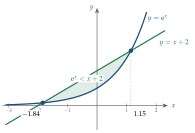
Figure 3 — Exam-style question 5, $\mathrm{e}^{x}=x+2$: no algebra, but the graphs meet twice.

Apply

  1. Solve $2^{x}=5-x$.
    Answer$x=1.72$
  2. Solve $x^{2}=\mathrm{e}^{x}$.
    Answer$x=-0.703$
  3. Solve $4-x^{2}=\mathrm{e}^{x}$.
    Answer$x=-1.96$ or $x=1.06$

III.3 An inequality from two graphs

Example 13

Solve $\mathrm{e}^{0.5x}\gt 3-x$.

What you do
What you write
Step 1 Graph both sides
$y=\mathrm{e}^{0.5x}$ and $y=3-x$
Step 2 Find where they meet
$x=1.18841\ldots$
Step 3 Read where the curve is above the line
$x\gt 1.19$

Apply

  1. Solve $2^{x}\lt 5-x$.
    Answer$x\lt 1.72$
  2. Solve $4-x^{2}\gt \mathrm{e}^{x}$.
    Answer$-1.96\lt x\lt 1.06$

IVExam-style questionsfrom the shortest to the longest · every one in steps, with its marks

A Straight lines

Exam-style question 1Paper 1 · no calculator · [Maximum mark: 7]

The points $A(-1,\,2)$ and $B(3,\,10)$ lie on the line $L_1$.

(a)Find the gradient of $L_1$.[2]
(b)Find the equation of $L_1$. Give your answer in the form $y=mx+c$.[2]

The line $L_2$ is perpendicular to $L_1$ and passes through $B$.

(c)Find the equation of $L_2$. Give your answer in the form $ax+by+d=0$, where $a,\,b,\,d\in\mathbb{Z}$.[3]
More questions like this

Working (a)

What you do
What you write
Step 1 Rise over run
$m=\dfrac{10-2}{3-(-1)}$
Step 2 Simplify
$=2$

Working (b)

What you do
What you write
Step 1 Point-gradient form through $A$
$y-2=2(x+1)$
Either point may be used.
Step 2 Make $y$ the subject
$y=2x+4$

Working (c)

What you do
What you write
Step 1 Perpendicular gradient: $-\dfrac1m$
gradient of $L_2$: $-\dfrac12$
$m_1m_2=-1$.
Step 2 Point-gradient form through $B$
$y-10=-\dfrac12(x-3)$
Through $B$, with their perpendicular gradient.
Step 3 Clear the fractions, all on one side
$x+2y-23=0$
Any integer multiple, such as $-2x-4y+46=0$.

Play this question in Mark it: find each mark yourself →

Exam-style question 2Paper 1 · no calculator · [Maximum mark: 6]

The line $L$ has equation $3x-4y+12=0$.

(a)Find the gradient of $L$.[2]
(b)Write down the coordinates of the points where $L$ meets the $x$-axis and the $y$-axis.[2]
(c)Find the area of the triangle enclosed by $L$ and the two axes.[2]
More questions like this

Working (a)

What you do
What you write
Step 1 Make $y$ the subject
$4y=3x+12$
Make $y$ the subject first.
Step 2 Read the gradient
$m=\dfrac34$

Working (b)

What you do
What you write
Step 1 $x$-axis: put $y=0$
$(-4,\,0)$
Put $y=0$.
Step 2 $y$-axis: put $x=0$
$(0,\,3)$
Put $x=0$.

Working (c)

What you do
What you write
Step 1 Half base times height, lengths positive
$\dfrac12\times4\times3$
The lengths are $4$ and $3$: a length is positive.
Step 2 Compute
$=6$

Play this question in Mark it: find each mark yourself →

B Domain and range

Exam-style question 3Paper 1 · no calculator · [Maximum mark: 6]

Let $f(x)=\sqrt{2x-6}+1$, for $x\ge a$, where $a$ is the smallest value for which $f$ is defined.

(a)Find the value of $a$.[2]
(b)Find the range of $f$.[2]
(c)Find the value of $x$ for which $f(x)=5$.[2]
More questions like this

Working (a)

What you do
What you write
Step 1 Under the root: $\ge0$
$2x-6\ge0$
The square root needs a number that is not negative.
Step 2 Solve
$a=3$

Working (b)

What you do
What you write
Step 1 The root is never negative
$\sqrt{2x-6}\ge0$
Step 2 Add the constant
$f(x)\ge1$
Or $y\ge1$, or $[1,\,\infty[$.

Working (c)

What you do
What you write
Step 1 Isolate the root, then square
$\sqrt{2x-6}=4\Rightarrow2x-6=16$
Step 2 Solve
$x=11$

Play this question in Mark it: find each mark yourself →

Exam-style question 4Paper 1 · no calculator · [Maximum mark: 5]

Let $f(x)=x^{2}-4x+1$, for $-1\le x\le5$.

(a)Write down the $y$-intercept of the graph of $f$.[1]
(b)Find the coordinates of the vertex of the graph of $f$.[2]
(c)Find the range of $f$.[2]
More questions like this

Working (a)

What you do
What you write
Step 1 $y$-intercept: $f(0)$
$1$
$f(0)=1$.

Working (b)

What you do
What you write
Step 1 Axis: $x=-\dfrac b{2a}$
$x=-\dfrac{-4}{2\times1}=2$
Step 2 Substitute to find $y$
$(2,\,-3)$

Working (c)

What you do
What you write
Step 1 Compute the ends of the domain
$f(-1)=6$, $f(5)=6$
The ends of the domain.
Step 2 Least and greatest values
$-3\le f(x)\le6$
The vertex gives the least value.

Play this question in Mark it: find each mark yourself →

C With the GDC (Paper 2)

Exam-style question 5Paper 2 · calculator · [Maximum mark: 5]

Let $f(x)=\mathrm{e}^{x}$ and $g(x)=x+2$.

(a)Find the $x$-coordinates of the points where the graphs of $f$ and $g$ intersect.[2]
(b)Hence solve the inequality $\mathrm{e}^{x}\lt x+2$.[2]
(c)Write down the range of $f$.[1]
More questions like this

Working (a)

What you do
What you write
Step 1 Intersections on the GDC
$x=-1.84$ ($-1.84140\ldots$)
$x=1.15$ ($1.14619\ldots$)

Working (b)

What you do
What you write
Step 1 Read where the line is above the curve
the line is above the curve between the intersections
Step 2 Write the interval
$-1.84\lt x\lt 1.15$

Working (c)

What you do
What you write
Step 1 Read the range from the graph
$f(x)\gt 0$
The curve never reaches the $x$-axis: $0$ is not in the range.

Play this question in Mark it: find each mark yourself →

Exam-style question 6Paper 2 · calculator · [Maximum mark: 6]

Let $f(x)=x^{3}-3x-1$, for $-2\le x\le2$.

(a)Find the zeros of $f$.[3]
(b)Find the range of $f$.[3]
More questions like this

Working (a)

What you do
What you write
Step 1 Zeros on the GDC
$x=-1.53$ ($-1.53208\ldots$)
$x=-0.347$ ($-0.347296\ldots$)
$x=1.88$ ($1.87938\ldots$)

Working (b)

What you do
What you write
Step 1 Find the extrema
local maximum $(-1,\,1)$, local minimum $(1,\,-3)$
From the GDC, or from $f'(x)=3x^{2}-3=0$.
Step 2 Compute the ends of the domain
$f(-2)=-3$, $f(2)=1$
Check the ends: here they equal the extrema.
Step 3 Least and greatest values
$-3\le f(x)\le1$

Play this question in Mark it: find each mark yourself →

VWhich method? Read the questionthe whole topic on one page

The question says
You write
Two points are given, say $A(1,\,3)$ and $B(4,\,9)$, and you must “find the gradient” of the line through them: $\dfrac{y_2-y_1}{x_2-x_1}$.
rise over run, signs kept D1
You must “find the equation of the line”: look for what the question gives you, a point and the gradient, even if the gradient has to be computed first.
$y-y_1=m(x-x_1)$, then the form asked P1
The line you want is “perpendicular” to a line or a gradient given: the two gradients satisfy $m_1m_2=-1$.
the negative reciprocal, $-\dfrac1m$ P2
The answer must be written with “$a,\,b,\,d\in\mathbb{Z}$”: the question wants the general form, with whole-number coefficients.
clear the fractions: $ax+by+d=0$ W1
A function is defined by a formula and you must “find the domain”: look for a root $\sqrt{\ }$, a fraction $\dfrac1{\ }$ or a $\ln$, the only things that forbid values.
what is under the root $\ge0$, the denominator $\ne0$, inside $\ln\gt 0$ P3
You must “find the range” of a function on a given domain: picture the graph on its domain, not on all of $\mathbb{R}$.
the least and greatest values: vertex, extrema and ends D2
You must “solve” an equation that mixes $\mathrm{e}$, $\ln$ or $\sin$ with $x$: no algebra will isolate $x$, so it is a Paper 2 question.
graph both sides; intersections on the GDC P5
In the exam 1

command terms

Write down: no working needed. Find: show the working. Hence: use the previous answer. Sketch: the shape, with the intercepts, the vertex and the asymptotes labelled. Domain: the $x$-values allowed. Range: the $y$-values reached.