AA SL · Geometry and trigonometry · course

Solids and 3D geometry.

AA SL resourcesPDF

Space adds one coordinate, $z$, and one difficulty: drawing. Every question of this topic comes back to a flat right-angled triangle hidden in the solid. Find it, draw it on its own, and the distance, the volume or the angle follows.

IPoints and solidsSL 3.1 · distance and midpoint in 3D, volume and surface area

I.1 Distance and midpoint in three dimensions

Definition 1

distance and midpoint in three dimensions

For $A(x_1,\,y_1,\,z_1)$ and $B(x_2,\,y_2,\,z_2)$: $AB=\sqrt{(x_2-x_1)^{2}+(y_2-y_1)^{2}+(z_2-z_1)^{2}}$ and $M\left(\frac{x_1+x_2}{2},\,\frac{y_1+y_2}{2},\,\frac{z_1+z_2}{2}\right)$.
Example 1

Find the distance between $P(2,\,-1,\,4)$ and $Q(5,\,3,\,-8)$, and the midpoint of $[PQ]$.

What you do
What you write
Step 1 The three differences
$3$, $4$, $-12$
Step 2 Square, add, square root
$PQ=\sqrt{9+16+144}=\sqrt{169}=13$
Step 3 Midpoint: the mean of each coordinate
$(3.5,\,1,\,-2)$

Apply

  1. The distance from $(0,\,0,\,0)$ to $(2,\,6,\,9)$.
    Answer$11$
  2. The distance from $(4,\,-3,\,1)$ to $(2,\,1,\,5)$.
    Answer$6$
  3. The midpoint of $(-2,\,5,\,0)$ and $(6,\,1,\,4)$.
    Answer$(2,\,3,\,2)$

I.2 Volume of a pyramid and of a cone

Property 1

volumes and surface areas

Right pyramid $V=\frac13Ah$ ($A$ the base area). Right cone $V=\frac13\pi r^{2}h$, curved surface $\pi rl$, slant height $l=\sqrt{r^{2}+h^{2}}$. Sphere $V=\frac43\pi r^{3}$, $S=4\pi r^{2}$; hemisphere $V=\frac23\pi r^{3}$, curved surface $2\pi r^{2}$.
Example 2

Find the volume of a pyramid with a rectangular base $6$ cm by $4$ cm and height $9$ cm, and of a cone with radius $3$ cm and height $7$ cm.

What you do
What you write
Step 1 Pyramid: base area, then $\frac13Ah$
$A=24$, $V=\frac13\times24\times9=72$ cm$^{3}$
Step 2 Cone: $\frac13\pi r^{2}h$
$\frac13\pi\times9\times7=21\pi$
Step 3 Round at the end
$66.0$ cm$^{3}$

Apply

  1. A pyramid with a square base of side $9$ cm and height $10$ cm.
    Answer$270$ cm$^{3}$
  2. A cone with radius $10$ cm and height $6$ cm.
    Answer$200\pi=628$ cm$^{3}$

I.3 Slant height and curved surface

Watch out 1
The height $h$ is vertical, from the apex to the centre of the base; the slant height $l$ runs along the surface. $V$ uses $h$; the curved surface uses $l$.
Example 3

A cone has radius $8$ cm and height $15$ cm. Find its slant height and its curved surface area.

What you do
What you write
Step 1 Right-angled triangle $h$, $r$, $l$
$l=\sqrt{8^{2}+15^{2}}=17$ cm
Step 2 Curved surface: $\pi rl$
$\pi\times8\times17=136\pi$
Step 3 Round at the end
$427$ cm$^{2}$
Figure 1 — Exam-style question 2. Height, radius and slant height form a right-angled triangle.

Apply

  1. $r=7$ cm, $h=24$ cm: slant height and curved surface.
    Answer$25$ cm; $175\pi=550$ cm$^{2}$
  2. $r=9$ cm, slant height $15$ cm: the height.
    Answer$12$ cm

I.4 Spheres and hemispheres

Example 4

A sphere has radius $4.5$ cm. Find its volume and its surface area.

What you do
What you write
Step 1 Volume: $\frac43\pi r^{3}$
$\frac43\pi\times4.5^{3}=121.5\pi=382$ cm$^{3}$
Step 2 Surface: $4\pi r^{2}$
$4\pi\times4.5^{2}=81\pi=254$ cm$^{2}$

Apply

  1. A hemisphere of radius $9$ cm: its volume.
    Answer$486\pi=1530$ cm$^{3}$
  2. A sphere has surface area $100\pi$ cm$^{2}$: its radius.
    Answer$5$ cm

I.5 Combined solids

Example 5

A solid is a cylinder of radius $3$ cm and height $10$ cm with a hemisphere on top. Find its volume and its total surface area.

What you do
What you write
Step 1 Volume: add the parts
$\pi\times9\times10+\frac23\pi\times27=90\pi+18\pi=108\pi=339$ cm$^{3}$
Step 2 List the outside surfacesNo flat face where the two parts meet.
the base, the side of the cylinder, the curved hemisphere
Step 3 Add them
$9\pi+60\pi+18\pi=87\pi=273$ cm$^{2}$

Apply

  1. A cone ($r=4$ cm, $h=3$ cm) on a cylinder ($r=4$ cm, $h=6$ cm): the volume.
    Answer$112\pi=352$ cm$^{3}$

IIAngles in solidsSL 3.1 · the angle between two lines, between a line and a plane

II.1 The angle between a line and a plane

Definition 2

the angle between a line and a plane

Drop a perpendicular from a point of the line to the plane: its foot gives the projection of the line. The angle with the plane is the angle between the line and its projection.
Property 2

the right-angled triangle

The line, its projection and the perpendicular form a right-angled triangle: $\tan\theta=\dfrac{\text{perpendicular}}{\text{projection}}$.
Watch out 2
The angle with the base is not the angle with an edge of the base. Find the projection first.
Example 6

A cuboid $ABCDEFGH$ has $AB=4$ cm, $BC=3$ cm and $AE=12$ cm. Find the angle between the diagonal $AG$ and the base $ABCD$.

What you do
What you write
Step 1 Projection of $AG$ on the base
$AC=\sqrt{4^{2}+3^{2}}=5$
Step 2 The perpendicular
$CG=12$
Step 3 $\tan\theta=\dfrac{\text{perpendicular}}{\text{projection}}$
$\tan\theta=\dfrac{12}{5}$, $\theta=67.4^{\circ}$
Figure 2 — Exam-style question 3. The angle with the base sits in the right-angled triangle $ACG$.

Apply

  1. A cuboid with base $5$ cm by $12$ cm and height $6$ cm: the angle between a long diagonal and the base.
    Answer$24.8^{\circ}$
  2. A square-based pyramid, side $8$ cm, apex $6$ cm above the centre: the angle between $VA$ and the base.
    Answer$46.7^{\circ}$

II.2 The angle between two lines

Example 7

In the cuboid of Example 6 ($AB=4$, $BC=3$, $AE=12$), find the angle $F\hat{A}C$ between the face diagonals $AF$ and $AC$.

What you do
What you write
Step 1 Three sides of triangle $AFC$, by Pythagoras
$AF=\sqrt{160}$, $AC=5$, $FC=\sqrt{153}$
Step 2 Cosine rule
$\cos\hat A=\dfrac{160+25-153}{2\times\sqrt{160}\times5}=0.25298\ldots$
Step 3 Answer
$\hat A=75.3^{\circ}$

Apply

  1. A cube of side $2$: the angle between the face diagonals $AC$ and $AF$.
    Answer$60^{\circ}$ (an equilateral triangle)

IIIExam-style questionsfrom the shortest to the longest · every one in steps, with its marks

A Points and spheres

Exam-style question 1Paper 1 · no calculator · [Maximum mark: 6]

The points $A(1,\,-2,\,3)$ and $B(5,\,2,\,1)$ are the ends of a diameter of a sphere.

(a)Find the distance $AB$.[2]
(b)Find the coordinates of the centre of the sphere.[2]
(c)Find the volume of the sphere. Give your answer in terms of $\pi$.[2]
More questions like this

Working (a)

What you do
What you write
Step 1 Square the differences, add, square root
$\sqrt{4^{2}+4^{2}+(-2)^{2}}$
Step 2 Compute
$AB=6$

Working (b)

What you do
What you write
Step 1 Midpoint: the mean of each coordinate
$\left(\dfrac{1+5}{2},\,\dfrac{-2+2}{2},\,\dfrac{3+1}{2}\right)$
The centre is the midpoint of the diameter.
Step 2 Write the point
$(3,\,0,\,2)$

Working (c)

What you do
What you write
Step 1 Radius: half of $AB$
$r=3$
Step 2 $V=\frac43\pi r^{3}$
$V=\dfrac43\pi\times3^{3}=36\pi$

Play this question in Mark it: find each mark yourself →

B A combined solid (Paper 2)

Exam-style question 2Paper 2 · calculator · [Maximum mark: 7]

A solid is made of a right cone on top of a hemisphere, as shown. The cone and the hemisphere both have radius $5$ cm; the height of the cone is $12$ cm.
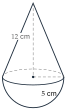
the diagram of the question
(a)Find the slant height of the cone.[2]
(b)Find the volume of the solid.[3]
(c)Find the total surface area of the solid.[2]
More questions like this

Working (a)

What you do
What you write
Step 1 Right-angled triangle $h$, $r$, $l$
$l^{2}=5^{2}+12^{2}$
Step 2 Compute
$l=13$ cm

Working (b)

What you do
What you write
Step 1 Volume of the cone
cone: $\dfrac13\pi\times5^{2}\times12=100\pi$
Step 2 Volume of the hemisphere
hemisphere: $\dfrac23\pi\times5^{3}=\dfrac{250\pi}{3}$
Step 3 Add
$V=576$ cm$^{3}$ ($575.958\ldots$)

Working (c)

What you do
What you write
Step 1 Outside surfaces only: cone and hemisphere
$\pi\times5\times13+2\pi\times5^{2}$
The curved surfaces only: the flat faces are inside the solid.
Step 2 Compute
$361$ cm$^{2}$ ($115\pi=361.283\ldots$)

Play this question in Mark it: find each mark yourself →

C Angles in solids (Paper 2)

Exam-style question 3Paper 2 · calculator · [Maximum mark: 6]

The diagram shows a cuboid $ABCDEFGH$ with $AB=8$ cm, $BC=6$ cm and $AE=5$ cm.
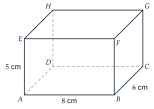
the diagram of the question
(a)Find $AC$.[2]
(b)Find $AG$.[2]
(c)Find the angle between $AG$ and the base $ABCD$.[2]
More questions like this

Working (a)

What you do
What you write
Step 1 Pythagoras in the base
$AC^{2}=8^{2}+6^{2}$
Step 2 Compute
$AC=10$ cm

Working (b)

What you do
What you write
Step 1 Pythagoras in triangle $ACG$
$AG^{2}=10^{2}+5^{2}$
Triangle $ACG$, right-angled at $C$.
Step 2 Compute
$AG=11.2$ cm ($\sqrt{125}=11.1803\ldots$)

Working (c)

What you do
What you write
Step 1 $\tan\theta=\dfrac{CG}{AC}$
$\tan\theta=\dfrac{5}{10}$
Or $\sin\theta=\dfrac{5}{11.18\ldots}$.
Step 2 Compute
$\theta=26.6^{\circ}$ ($26.5650\ldots$)

Play this question in Mark it: find each mark yourself →

Exam-style question 4Paper 2 · calculator · [Maximum mark: 6]

A right pyramid $VABCD$ has a square base $ABCD$ of side $10$ cm. Its apex $V$ is $12$ cm vertically above the centre $O$ of the base.
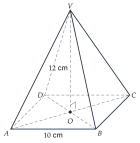
the diagram of the question
(a)Find the volume of the pyramid.[2]
(b)Find the height of the triangular face $VAB$, from $V$ to the midpoint of $AB$.[2]
(c)Find the angle between the edge $VA$ and the base $ABCD$.[2]
More questions like this

Working (a)

What you do
What you write
Step 1 $V=\frac13Ah$
$\dfrac13\times10^{2}\times12$
Step 2 Compute
$V=400$ cm$^{3}$

Working (b)

What you do
What you write
Step 1 Right-angled triangle: height and half the side
$\sqrt{12^{2}+5^{2}}$
From $O$ to the midpoint of $AB$ is half a side, $5$.
Step 2 Compute
$13$ cm

Working (c)

What you do
What you write
Step 1 Projection $OA$, then $\tan\theta$
$OA=5\sqrt2$, $\tan\theta=\dfrac{12}{5\sqrt2}$
$OA$ is half the diagonal of the base: the projection of $VA$.
Step 2 Compute
$\theta=59.5^{\circ}$ ($59.4910\ldots$)

Play this question in Mark it: find each mark yourself →

IVWhich method? Read the questionthe whole topic on one page

The question says
You write
Two points are given with three coordinates each, and you must find the distance between them: $AB=\sqrt{\Delta x^{2}+\Delta y^{2}+\Delta z^{2}}$.
the differences, squared, added, square root D1
You must find a “centre” or a “midpoint” in space: take the mean of each coordinate.
$\left(\frac{x_1+x_2}{2},\,\ldots\right)$ D1
A cone is described by two of its radius, height and slant height: they are linked by $l^{2}=r^{2}+h^{2}$.
$V$ with $h$, curved surface with $l$ P1
The question says “the solid is made of” a cylinder and a cone, or similar: add the volumes.
surface: only the outside faces P1
You must find the “angle between the line and the plane” in a solid: you need the projection of the line on the plane.
the right-angled triangle, then $\tan\theta$ P2
You must find the angle between two lines inside a solid, such as two diagonals: make a triangle and find its three sides.
Pythagoras for the sides, then the cosine rule P2
The answer must be given “in terms of $\pi$”: it is an exact answer.
keep $\pi$; no decimal
In the exam 1

command terms

Find: show the formula with the numbers in it, then the answer to $3$ s.f. with units. In terms of $\pi$: an exact answer, for example $36\pi$. Show that: every step, ending on the given result.