AA HL · Differential calculus · course

Optimisation.

AA HL resourcesPDF

The longest question of Paper 1 or Paper 2 is often an optimisation: a largest volume, a least cost, a greatest profit. The calculus is short; the marks are in the set-up (one variable, its domain), the justification, and the answer to the question actually asked. Each part ends with exam-style questions, marked line by line.

IOptimising a given functionSL 5.8 · the greatest or least value of a model

I.1 The greatest value of a model

Property 1

the method

(1) solve $Q'(x)=0$; (2) justify the maximum or minimum, by $Q'$ or $Q''$; (3) on a closed domain, compare with the ends; (4) answer the question, with units.
Watch out 1
“Find the maximum profit” asks for a value of $P$, not of $x$: read the question again before the last line.
Example 1

A profit, in thousands of euros, is $P(x)=-2x^{2}+48x-100$. Find the value of $x$ that gives the greatest profit, and that profit.

What you do
What you write
Step 1 Solve $P'(x)=0$
$-4x+48=0$: $x=12$
Step 2 Justify
$P''(x)=-4\lt 0$: a maximum
Step 3 Answer: the value of $P$
$P(12)=188$ thousand euros

Apply

  1. $C(x)=2x^{2}-20x+70$: the least cost.
    Answer$20$, at $x=5$
  2. $h(t)=30t-5t^{2}$ metres: the greatest height.
    Answer$45$ m, at $t=3$

I.2 A closed domain: the ends count

Example 2

Find the greatest and the least value of $f(x)=x^{3}-6x^{2}+9x$ for $0\le x\le5$.

What you do
What you write
Step 1 Stationary points
$3(x-1)(x-3)=0$: $f(1)=4$, $f(3)=0$
Step 2 The ends
$f(0)=0$, $f(5)=20$
Step 3 Compare
greatest $20$ (at $x=5$), least $0$
Figure 1 — When the domain stops early, the greatest value is at the end.

Apply

  1. $R(p)=p(300-10p)$, with $p\ge18$: the greatest revenue.
    Answer$R(18)=2160$ ($R$ decreases after $p=15$)
  2. $f(x)=x^{2}-6x$, $0\le x\le4$: greatest and least.
    Answer$0$; $-9$

IISetting up the functionSL 5.8 · one variable, from a constraint

II.1 From two variables to one

Property 2

from two variables to one

A constraint (fixed perimeter, area, volume) links the two variables: solve it for one, substitute, and write the domain of the other.
Example 3

Positive numbers $x$ and $y$ satisfy $x+2y=30$. Find the greatest value of $A=xy$.

What you do
What you write
Step 1 Solve the constraint for $y$
$y=\dfrac{30-x}{2}$
Step 2 Substitute: one variable
$A=15x-\dfrac{x^{2}}{2}$
Step 3 Solve $A'(x)=0$, justify
$15-x=0$: $x=15$; $A''=-1\lt 0$
Step 4 Answer
$A=15\times7.5=112.5$

Apply

  1. A rectangle has perimeter $36$ cm: its greatest area.
    Answer$81$ cm$^{2}$ (a square)
  2. $x+y=10$: the least value of $x^{2}+y^{2}$.
    Answer$50$

II.2 A box, or a can

Watch out 2
“Show that $V=\ldots$”: write the constraint on the page, then the substitution.
Example 4

An open box is made from a $24$ cm square sheet by cutting a square of side $x$ cm from each corner. Find the greatest volume.

What you do
What you write
Step 1 Volume with one variable
$V=x(24-2x)^{2}$, $0\lt x\lt 12$
Step 2 Solve $V'(x)=0$
$(24-2x)(24-6x)=0$: $x=4$ ($x=12$ rejected)
Step 3 Compute
$V=4\times16^{2}=1024$ cm$^{3}$
Figure 2 — The best box is neither too shallow nor too deep.

Apply

  1. A closed box with a square base of side $x$ and volume $1000$ cm$^{3}$: the least surface area.
    Answer$S=2x^{2}+\frac{4000}{x}$: $600$ cm$^{2}$
  2. An open can of volume $64\pi$ cm$^{3}$: the least area of metal.
    Answer$r=4$: $48\pi$ cm$^{2}$

IIIJustifying, and the answer askedSL 5.8 · the reasons that earn the R1, and the domain

III.1 Three ways to justify

Property 3

three ways to justify

The second derivative at the point; the sign of the first derivative on each side; on Paper 2, the graph, sketched. On a closed interval, compare the ends too.
Example 5

A closed can has volume $54\pi$ cm$^{3}$, so its surface area is $S=2\pi r^{2}+\dfrac{108\pi}{r}$. Find the least surface area, and justify.

What you do
What you write
Step 1 Solve $S'(r)=0$
$4\pi r-\dfrac{108\pi}{r^{2}}=0$: $r^{3}=27$, $r=3$
Step 2 Justify with $S''$
$S''=4\pi+\dfrac{216\pi}{r^{3}}\gt 0$: a minimum
Step 3 Answer
$S=18\pi+36\pi=54\pi$ cm$^{2}$
Figure 3 — The least metal for a fixed volume.

Apply

  1. $A(x)=60x-3x^{2}$: justify the maximum at $x=10$ with the sign of $A'$.
    Answer$A'(9)=6\gt 0$, $A'(11)=-6\lt 0$

III.2 A root outside the domain; whole numbers

Watch out 3
A root of $Q'(x)=0$ outside the domain is rejected, with the reason. For whole numbers of items, compare the two integers either side.
Example 6

A daily profit is $P(n)=-3n^{2}+100n-200$ euros for $n$ items, $n$ a whole number. Find the best $n$ and the greatest profit.

What you do
What you write
Step 1 Solve $P'(n)=0$
$n=16.67$, not a whole number
Step 2 Compare the integers either side
$P(16)=632$, $P(17)=633$
Step 3 Answer
$17$ items, $633$ euros

Apply

  1. $P(n)=-n^{2}+25n$, $n$ whole: the greatest value.
    Answer$156$, at $n=12$ or $13$

III.3 On the GDC

Example 7

Find the point $P\big(x,\,\mathrm{e}^{x}\big)$ of the curve $y=\mathrm{e}^{x}$ nearest to $A(0,\,2)$.

What you do
What you write
Step 1 The distance with one variable
$AP=\sqrt{x^{2}+\left(\mathrm{e}^{x}-2\right)^{2}}$
Step 2 Minimum of its graph on the GDC
$x=0.524$, $AP=0.609$
Step 3 The point
$P(0.524,\,1.69)$

Apply

  1. Cost $C(x)=3(8-x)+5\sqrt{x^{2}+4}$, $0\le x\le8$: the least cost.
    Answer$32$, at $x=1.5$

IVExam-style questionsfrom the shortest to the longest · every one in steps, with its marks

A A given function

Exam-style question 1Paper 1 · no calculator · [Maximum mark: 6]

A company makes and sells $x$ thousand units of a product a month. Its monthly profit, in thousands of euros, is modelled by $P(x)=-0.4x^{2}+24x-200$, for $0\le x\le50$.

(a)Find $P'(x)$.[1]
(b)Find the value of $x$ that gives the greatest profit. Justify your answer.[3]
(c)Find the greatest monthly profit.[2]
More questions like this

Working (a)

What you do
What you write
Step 1 Differentiate
$P'(x)=-0.8x+24$

Working (b)

What you do
What you write
Step 1 Solve $P'(x)=0$
$-0.8x+24=0$
$x=30$
Step 2 Justify with $P''$
$P''(x)=-0.8\lt 0$, so a maximum
Or: $P'$ changes from $+$ to $-$ at $x=30$.

Working (c)

What you do
What you write
Step 1 Substitute
$P(30)=-360+720-200$
Substitute into $P$, not into $P'$.
Step 2 Answer with units
$160$ thousand euros
Accept $160$, or $160\,000$ euros.

Play this question in Mark it: find each mark yourself →

Exam-style question 2Paper 1 · no calculator · [Maximum mark: 6]

A theatre sells $600-20x$ tickets for a show when the price of a ticket is $x$ francs. The revenue from the tickets is $R(x)=x(600-20x)$ francs.

(a)Find the price that gives the greatest revenue, and this revenue.[4]

The theatre decides that the price of a ticket must be at least $18$ francs.

(b)Find the greatest revenue under this condition. Justify your answer.[2]
More questions like this

Working (a)

What you do
What you write
Step 1 Differentiate
$R'(x)=600-40x$
Expand first: $R(x)=600x-20x^{2}$.
Step 2 Solve $R'(x)=0$
$600-40x=0$
$x=15$ francs
Step 3 The revenue
$R(15)=4500$ francs

Working (b)

What you do
What you write
Step 1 $R$ decreases after $15$: the end counts
$R'(x)\lt 0$ for $x\gt 15$: $R$ decreases on $x\ge18$, so the greatest value is at $x=18$
The stationary point is outside the allowed prices: the end of the domain wins.
Step 2 $R(18)$
$R(18)=18\times240=4320$ francs

Play this question in Mark it: find each mark yourself →

B Setting up the function

Exam-style question 3Paper 1 · no calculator · [Maximum mark: 7]

An open box is made from a rectangular sheet of card $30$ cm by $16$ cm, by cutting a square of side $x$ cm from each corner and folding up the sides.

(a)Show that the volume of the box is $V=x(30-2x)(16-2x)$, and write down the possible values of $x$.[2]
(b)Show that $\dfrac{\mathrm{d}V}{\mathrm{d}x}=4(3x-10)(x-12)$.[3]
(c)Find the value of $x$ that gives the greatest volume, and this volume.[2]
More questions like this

Working (a)

What you do
What you write
Step 1 Base and height from the folding
base $(30-2x)$ by $(16-2x)$, height $x$
Each side of the base loses $x$ at both ends.
Step 2 Every length positive
$0\lt x\lt 8$
$16-2x\gt 0$: the narrow side decides.

Working (b)

What you do
What you write
Step 1 Expand
$V=4x^{3}-92x^{2}+480x$
Expand before differentiating.
Step 2 Differentiate
$\dfrac{\mathrm{d}V}{\mathrm{d}x}=12x^{2}-184x+480$
Step 3 Factorise
$=4\left(3x^{2}-46x+120\right)=4(3x-10)(x-12)$

Working (c)

What you do
What you write
Step 1 Reject the root outside the domain
$x=\dfrac{10}{3}$ ($x=12$ is outside $0\lt x\lt 8$)
The other root is rejected, and the reason written.
Step 2 Compute
$V=\dfrac{10}{3}\times\dfrac{70}{3}\times\dfrac{28}{3}=\dfrac{19600}{27}$ cm$^{3}$
$\approx726$ cm$^{3}$.

Play this question in Mark it: find each mark yourself →

Exam-style question 4Paper 1 · no calculator · [Maximum mark: 7]

A farmer has $60$ m of fencing to make a rectangular enclosure against a long straight wall. The wall forms one side, so only three sides need fencing. The sides perpendicular to the wall have length $x$ metres.
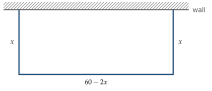
the diagram of the question
(a)Show that the area of the enclosure is $A=60x-2x^{2}$.[2]
(b)Find the value of $x$ for which the area is greatest. Justify your answer.[3]
(c)Find the greatest area.[2]
More questions like this

Working (a)

What you do
What you write
Step 1 The third side from the fencing
the third side is $60-2x$
The constraint: $2x+y=60$.
Step 2 The area
$A=x(60-2x)=60x-2x^{2}$

Working (b)

What you do
What you write
Step 1 Solve $A'(x)=0$
$A'(x)=60-4x=0$
$x=15$
Step 2 Justify with $A''$
$A''(x)=-4\lt 0$: a maximum

Working (c)

What you do
What you write
Step 1 Substitute
$A=15\times30$
Step 2 Answer with units
$450$ m$^{2}$

Play this question in Mark it: find each mark yourself →

Exam-style question 5Paper 1 · no calculator · [Maximum mark: 6]

A closed cylindrical can has radius $r$ cm and height $h$ cm. Its volume is $128\pi$ cm$^{3}$.

(a)Show that the total surface area of the can is $S=2\pi r^{2}+\dfrac{256\pi}{r}$.[2]
(b)Find the value of $r$ for which $S$ is least. Justify your answer.[3]
(c)Find the least surface area, as a multiple of $\pi$.[1]
More questions like this

Working (a)

What you do
What you write
Step 1 Solve the volume for $h$
$\pi r^{2}h=128\pi$, so $h=\dfrac{128}{r^{2}}$
The constraint, solved for $h$.
Step 2 Surface area
$S=2\pi r^{2}+2\pi rh$
Two discs and the curved surface.
Step 3 Substitute
$=2\pi r^{2}+2\pi r\times\dfrac{128}{r^{2}}=2\pi r^{2}+\dfrac{256\pi}{r}$

Working (b)

What you do
What you write
Step 1 Solve $S'(r)=0$
$\dfrac{\mathrm{d}S}{\mathrm{d}r}=4\pi r-\dfrac{256\pi}{r^{2}}=0$
$r^{3}=64$, $r=4$
Step 2 Justify with $S''$
$\dfrac{\mathrm{d}^{2}S}{\mathrm{d}r^{2}}=4\pi+\dfrac{512\pi}{r^{3}}\gt 0$: a minimum

Working (c)

What you do
What you write
Step 1 Substitute $r=4$
$S=32\pi+64\pi=96\pi$ cm$^{2}$

Play this question in Mark it: find each mark yourself →

C With the GDC (Paper 2)

Exam-style question 6Paper 2 · calculator · [Maximum mark: 6]

A cable joins a station $A$ on a straight shore to an island $I$, $3$ km from the shore. The point $B$ of the shore nearest to $I$ is $10$ km from $A$. The cable runs along the shore from $A$ to a point $P$, then under water from $P$ to $I$. Let $BP=x$ km. Cable costs $2.4$ million euros per km along the shore and $4.1$ million euros per km under water.
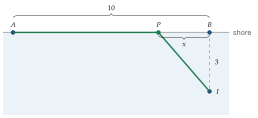
the diagram of the question
(a)Show that the cost of the cable, in millions of euros, is $C(x)=2.4(10-x)+4.1\sqrt{x^{2}+9}$, for $0\le x\le10$.[2]
(b)Find the value of $x$ that gives the least cost, and this least cost.[4]
More questions like this

Working (a)

What you do
What you write
Step 1 Along the shore
$AP=10-x$
Step 2 Under water: Pythagoras
$PI=\sqrt{x^{2}+9}$, by Pythagoras

Working (b)

What you do
What you write
Step 1 Minimum on the GDC
use of GDC (minimum of the graph), or $C'(x)=0$
Step 2 Read $x$
$x=2.17$ km ($2.16596\ldots$)
Step 3 Read $C$
$C=34.0$ million euros ($33.9724\ldots$)
Step 4 Compare with the ends
less than $C(0)=36.3$ and $C(10)=42.8$
The ends of the interval are compared: the minimum is global.

Play this question in Mark it: find each mark yourself →

Exam-style question 7Paper 2 · calculator · [Maximum mark: 5]

Let $A$ be the point $(1,\,3)$, and $P\big(x,\,\ln x\big)$ a point on the curve $y=\ln x$, for $x\gt 0$.

(a)Write down an expression for the distance $AP$ in terms of $x$.[1]
(b)Find the coordinates of the point $P$ for which the distance $AP$ is least, and this least distance.[4]
More questions like this

Working (a)

What you do
What you write
Step 1 Distance formula
$AP=\sqrt{(x-1)^{2}+(\ln x-3)^{2}}$

Working (b)

What you do
What you write
Step 1 Minimum on the GDC
minimum of the graph of $AP$ on the GDC
The minimum of $AP^{2}$ is at the same $x$: easier, if done by hand.
Step 2 Read $x$
$x=2.09$ ($2.08582\ldots$)
Step 3 The point
$P(2.09,\,0.735)$
$y=\ln x$: the point is on the curve.
Step 4 The distance
$AP=2.51$ ($2.51167\ldots$)

Play this question in Mark it: find each mark yourself →

VWhich method? Read the questionthe whole topic on one page

The question says
You write
You must “find the maximum” or “minimum value of $Q$”, a quantity written with one variable.
$Q'(x)=0$, justify, then $Q$ at that $x$, with units P1
You must “show that $V=\ldots$”, but the shape is described with two variables: the context gives a constraint that links them.
write the constraint, solve it for one variable, substitute P2
You must “write down the possible values of $x$” in the context: lengths are positive.
every length positive: the domain, e.g. $0\lt x\lt 8$ P2
You must “justify” that your value is a maximum or a minimum: there are three ways.
$Q''\lt 0$ or $\gt 0$; the sign of $Q'$ either side; a sketch on Paper 2 P3
The variable is restricted to a closed interval, or a condition on $x$ is given: the ends count.
compare the stationary value with the values at the ends P1
Solving $Q'(x)=0$ gives a root outside the domain: it is rejected.
say why: “$x=12$ is not possible since $x\lt 8$” W3
The context counts whole items, such as boxes or seats: the answer must be an integer.
compare the two integers either side of the stationary point W3
On Paper 2, the function is too long to differentiate by hand: the GDC is allowed.
on the GDC: Maximum, Minimum on the graph, with the domain as window
In the exam 1

command terms

Show that: the constraint and the substitution written. Find the value of $x$: the variable; find the maximum: the quantity. Justify: a reason that earns its own mark. Exact: keep $\pi$, fractions, roots. Units: in the answer, always.